
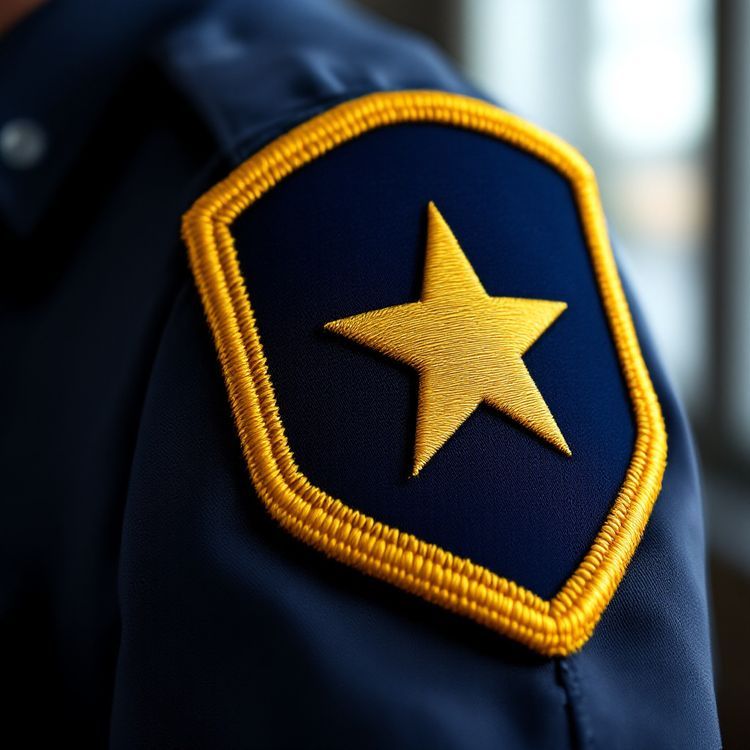
A thin blue line patch is usually a subdued black and gray design, often a US flag, with a single blue stripe across the middle, made as an embroidered or woven patch with a hook-and-loop or sew-on backing. To those who wear it, the blue line stands for law enforcement officers. Other colours are used by other services: red for firefighters is the best known. Before you order for wear on a uniform, check your agency's policy, because many departments set their own rules on whether these patches may be worn on duty.
Below we explain what each line commonly represents, the policy and flag points to check, how to design a thin line that stitches well, and the sizes and backings that suit uniforms, gear and memorial patches.
What the line colours commonly represent
Thin line colours are informal. No official body defines them, meanings vary by region, and some colours are used by more than one group. The table shows the associations most people in these services recognize.
| Line colour | Commonly associated with |
|---|---|
| Blue | Law enforcement officers |
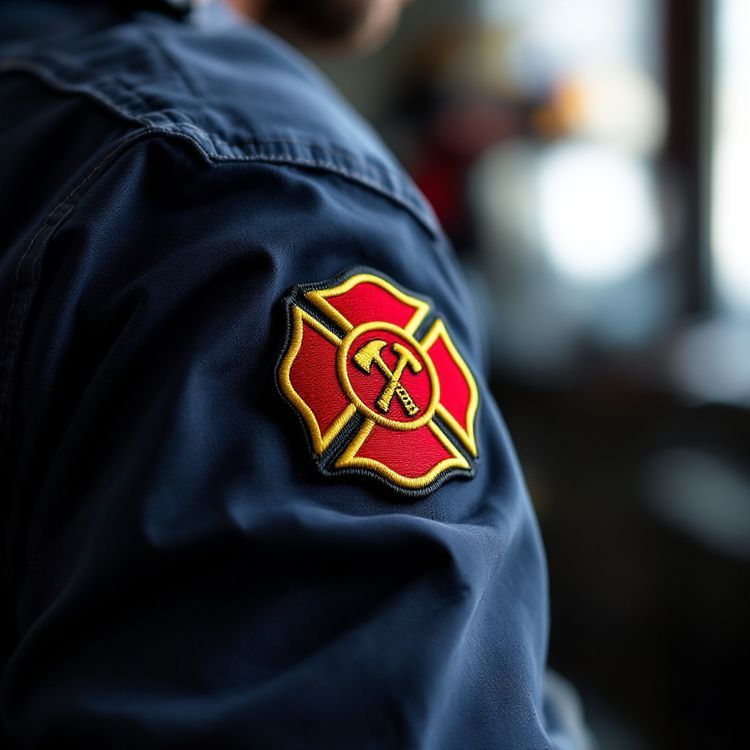
| Red | Firefighters |
| White | Emergency medical services |
| Gold | 911 dispatchers and telecommunicators |
| Silver or gray | Corrections officers |
| Green | Varies: often federal agents, border or conservation officers |
| Orange | Varies: often search and rescue |
Some designs combine two lines, such as blue and red for a family with both an officer and a firefighter, or for a joint public safety department. If your group uses a colour differently from the table, that is common; design for how your members understand it. Our guides to 911 dispatcher patches and corrections officer patches cover those services' wider patch needs.
Check agency policy before on-duty wear
Many agencies set their own policy on thin line patches. Some allow them on tactical gear or approved outer carriers, some allow them only off duty, and some do not allow them on the uniform at all. Policies also change, so a patch allowed last year may not be allowed now.
- Read your agency's current uniform and appearance policy before ordering for duty wear.
- If the policy is unclear, ask your chain of command or uniform committee in writing.
- Associations, unions and family support groups usually order for off-duty wear, gifts or fundraising, where agency rules on uniforms do not apply in the same way.
- Keep any agency patch, seal or badge out of the design unless the agency has authorized it.
We make thin line patches for agencies, associations, nonprofits and families. We do not reproduce an agency's official patch or badge without that agency's authorization.
Flag-based designs: orientation and the Flag Code
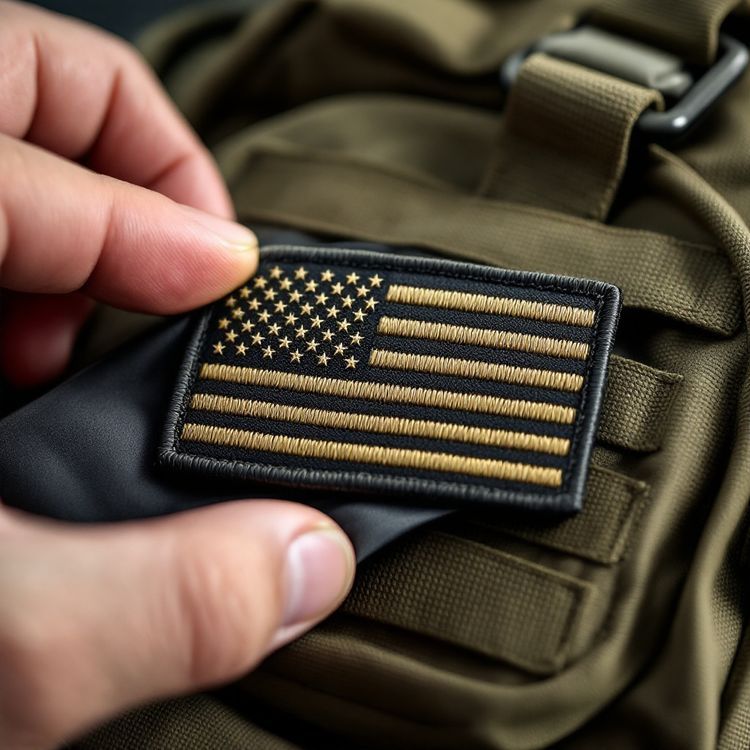
The most common thin line patch is a US flag in black and gray with one coloured stripe. Two points are worth knowing before you design one.
Orientation
On a uniform, a flag patch worn on the right shoulder is usually reversed, with the stars at the top right, so that the flag appears to move forward with the wearer. A patch for the left shoulder, a cap or a bag uses the standard orientation. If members will wear the patch on both sides, order both versions. Our American flag patches guide explains orientation and sizes in more detail.
The Flag Code
The US Flag Code (4 U.S.C. 8) advises that nothing should be placed on the flag and that it should not be altered, and some people raise it when discussing modified flag designs. The Flag Code is guidance; it sets out customs for displaying the flag and does not carry penalties for civilians. Whether to use a flag-based design is your organization's decision. Groups that prefer to avoid the question often use a plain black field with a single coloured line, or a thin line running across their own emblem.
Designing a thin line that stitches cleanly
The design is simple, but the line itself needs care. A line that is too thin can break up in embroidery or vanish from a distance.
- Make the coloured line at least about 1/8 in (3 mm) tall on a standard flag patch. Thinner than about 1 mm does not stitch cleanly.
- Choose the line colour by thread or Pantone reference, and check it on the proof against a real uniform.
- Keep subdued areas to two or three grays and black, so the coloured line stands out.
- For very fine stripes or small lettering such as a unit number, choose woven construction.
- For memorial patches, check every name, badge number and date on the proof, letter by letter.
Embroidered thin line patches have a raised, textured look and stand up to gear wear. Woven versions are flatter and sharper, and suit small sizes or designs with a motto. Either can take a merrowed border on a rectangle or a heat cut edge on a custom shape. For uniform shoulder patch construction more broadly, see our police patches page.
Sizes and backings
Common flag patch sizes are about 2 x 3 in (51 x 76 mm) and 2 x 3.5 in (51 x 89 mm). Smaller versions of about 1 x 2 in (25 x 51 mm) suit caps. Circular or shield thin line designs for sleeves are usually 3 to 3.5 in (76 to 89 mm).
Hook-and-loop backing is the most popular choice, because it lets the patch move between a backpack, a plate carrier, a range bag and a jacket, and lets officers remove it where policy requires. Our guide to custom Velcro patches explains how the two sides work and which side goes on the patch. Sew-on backing suits jackets and caps for permanent wear, and iron-on suits cotton shirts and canvas bags.
Memorial and fundraising patches
Thin line patches are often made to honor someone. A memorial patch might add a name, a badge or unit number and a date to a subdued flag or line design, and officers and family members wear it for a period after a loss or at an annual remembrance. Associations and family support groups also sell thin line patches to raise money for families, scholarships or memorial events. Our guide to fundraising patches covers how to plan a run you intend to sell.
The same design can carry over to lapel pins and challenge coins for a memorial service or an anniversary. Keep the tone of every piece consistent with the family's wishes, and have someone close to them approve the proof.
Ordering a thin line patch
Send your artwork or a sketch (AI, EPS or PDF are cleanest; a PNG or a photo of a patch you like is enough to start), the size, quantity, backing and in-hands date. We return a quote in 2 to 3 business days and a proof about 1 to 3 business days after artwork. Production takes about 3 to 4 weeks after written approval, and a rush of around 10 business days is sometimes possible for a memorial date. The minimum starts from 100 pieces and is confirmed on your quote. When you are ready, request a quote.
