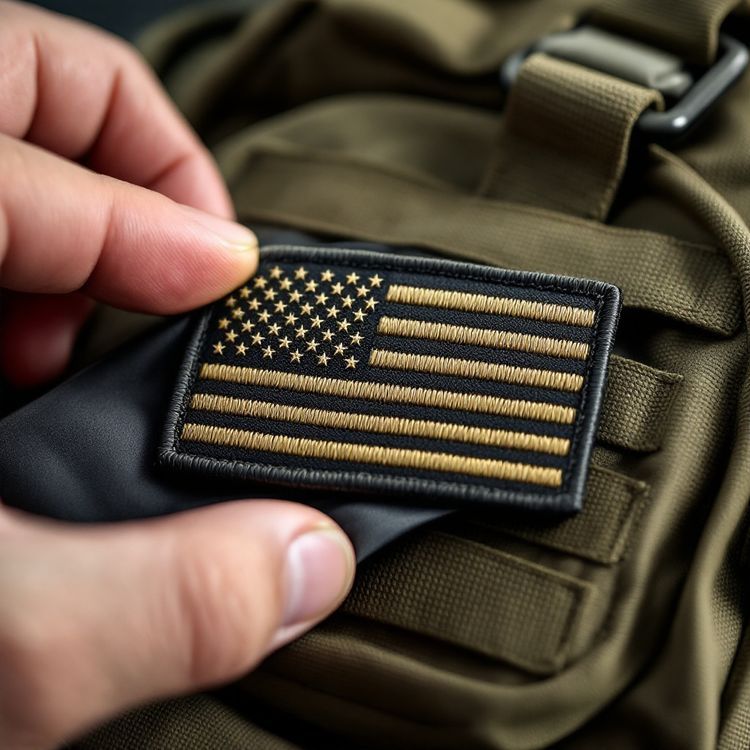
An American flag patch on the left sleeve or chest shows the flag the normal way, with the union (the blue field of stars) at the top left. On the right sleeve it is usually reversed, with the union at the top right, so the stars face forward, as if the flag were flying from a pole while the wearer moves ahead. That convention comes from military uniform rules, such as the US Army's. A common uniform size is about 2 by 3 in (51 by 76 mm). The US Flag Code says the flag should not be used as a costume or athletic uniform, but it specifically allows a flag patch on the uniforms of military personnel, firefighters, police officers and members of patriotic organizations.
Below we go through orientation, sizes and colour versions, what the Flag Code says, and how to order flag patches for a department, unit or team.
Orientation: why the flag is reversed on the right
A flag on a pole always has the union nearest the pole. When a flag moves forward, it streams backward, so the union leads. Uniform rules carry that idea onto the body: the stars should always face the direction the wearer is walking.
- Left sleeve or left chest: the wearer faces left as seen from the side, so the normal flag (union top left) already has its stars forward.
- Right sleeve: the normal flag would have its stars pointing backward, so a reversed flag (union top right) is used. This is often called a reverse flag or right-facing flag.
The Army sets this out in its uniform regulation (AR 670-1), which places the flag on the right shoulder in the reversed orientation. Other services, police departments and fire departments set their own uniform policies, and placements vary. If you are ordering for an agency, check its written uniform policy first. For a civilian jacket or gear, the same convention is a sensible guide.
Common sizes
| Use | Typical size | Common backing |
|---|---|---|
| Military-style uniform sleeve | About 2 by 3 in (51 by 76 mm) | Hook-and-loop or sew-on |
| Police, fire or EMS sleeve | About 2 by 3 in (51 by 76 mm) up to 2.5 by 3.5 in (64 by 89 mm) | Sew-on |
| Cap front or side | About 1.5 by 2.5 in (38 by 64 mm) | Sew-on or hook-and-loop |
| Backpack, plate carrier or range bag | About 2 by 3 in (51 by 76 mm) up to 3 by 5 in (76 by 127 mm) | Hook-and-loop |
| Jacket or vest chest | About 2 by 3.5 in (51 by 89 mm) | Sew-on or iron-on |
The official flag's proportions are 1 to 1.9, set by executive order, but most patches use a simpler 2 to 3 ratio that fits uniform layouts. Either is fine for a patch; just keep all the patches in one order the same.
Full colour, subdued and other versions
Full colour
Red, white and blue. Used on dress and service uniforms, police and fire shirts, jackets, caps and merch.
Subdued
Muted tones that blend with field and tactical uniforms: black and gray, olive and tan, or colours matched to a camouflage pattern. Subdued flags keep the shape and pattern of the flag but lower its visibility. They are common on plate carriers, packs and range gear.
Embroidered or woven
Fifty stars are a lot of detail at 2 by 3 in. Embroidery can hold them, but the stars become small stitched marks rather than crisp points. A woven flag patch holds the stars and the thirteen stripes more sharply at that size. Our comparison of embroidered and woven patches shows why fine detail favors woven. Embroidered flags have more texture and suit larger sizes and jackets.
Department and unit variations
Many departments and units add a line, a name, a crest or a single coloured stripe to a flag patch. Those are custom designs, and your agency or unit policy decides whether they can be worn on duty.
What the US Flag Code says about patches
The US Flag Code is in Title 4 of the United States Code, chapter 1. Section 8, on respect for the flag, includes these points relevant to patches:
- No part of the flag should be used as a costume or athletic uniform.
- However, a flag patch may be affixed to the uniform of military personnel, firefighters, police officers and members of patriotic organizations.
- A lapel flag pin, being a replica, should be worn on the left lapel near the heart.
- The flag should not be used for advertising, and should not be embroidered on items such as cushions or handkerchiefs.
- A flag in such condition that it is no longer a fitting emblem for display should be destroyed in a dignified way, preferably by burning.
For civilians, the Flag Code is generally understood as guidance on etiquette rather than a law enforced with penalties, and plenty of flag patches are worn on civilian jackets, caps and gear. Read the Flag Code itself (Title 4, chapter 1 of the US Code) for the exact wording, and follow your agency's or organization's uniform policy where one applies.
Wearing, swapping and retiring flag patches
- Put the patch on before it is needed for a ceremony, and check the orientation on the body, not on the table.
- On gear with a loop panel, a hook-and-loop flag lets you remove it for travel or swap between full colour and subdued. Our hook-and-loop patch guide covers how it attaches.
- Wash patched uniforms inside out and cool to keep the red and blue bright.
- Replace a patch that is faded, frayed or torn. The Flag Code's guidance on worn flags is often applied to patches too.
- Many veterans' organizations and some scout troops collect worn flags for respectful retirement, and will usually accept patches as well.
Ordering flag patches
For a department, unit or team, tell us on your quote request whether you need normal, reversed or both orientations, and in what split. List the size, colours (full colour or a subdued scheme), backing and quantity. Flag patches for uniforms are common across our military patches and police patches. For unit patches that go alongside the flag, see our military and unit patches guide. Send your request and we reply within about 2 to 3 business days.