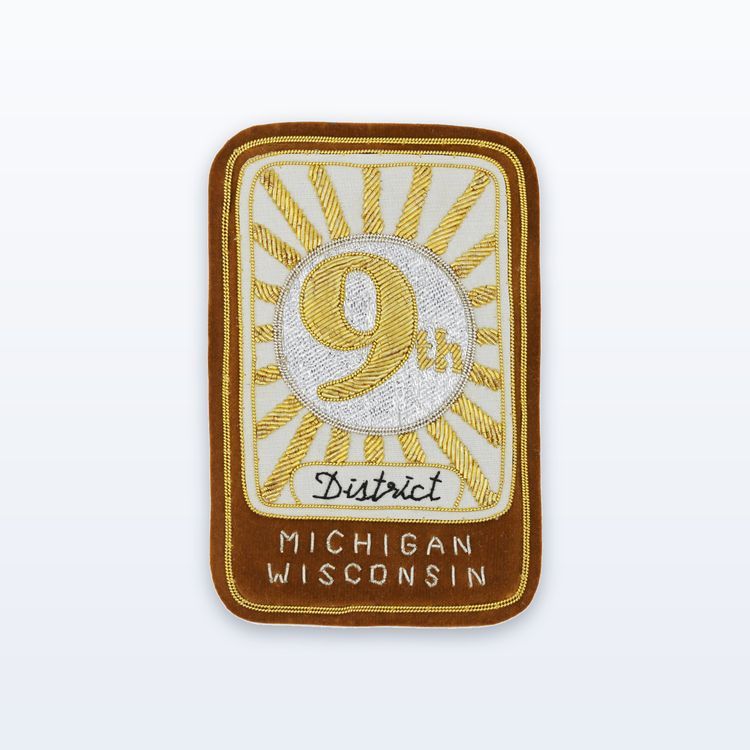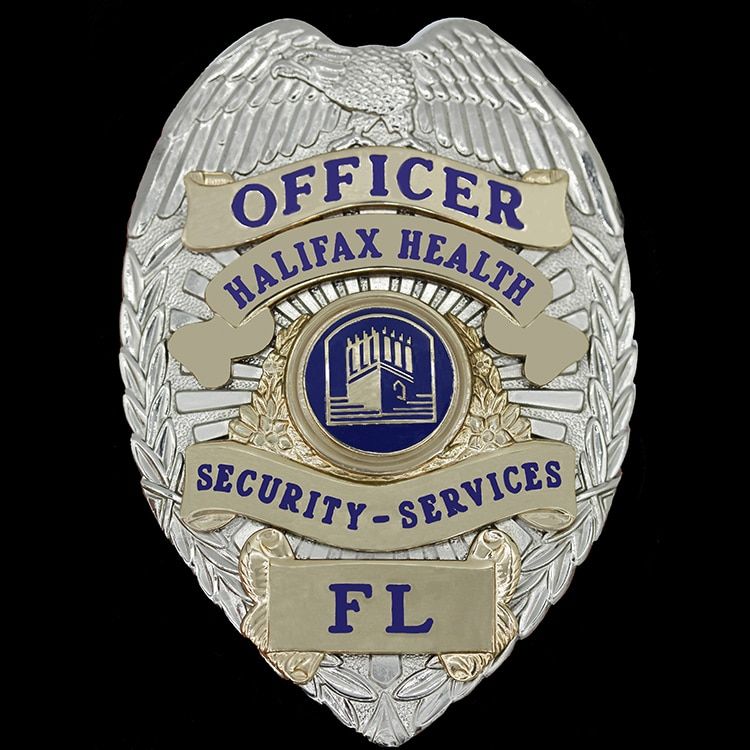
Corrections officer patches are usually a pair of embroidered shoulder patches, about 3.5 to 4.5 in (89 to 114 mm) wide, with the agency or facility name, the word CORRECTIONS or DETENTION, and the state or county emblem, on a sew-on backing for daily laundering. The specs that matter most are the exact size, thread colours, border colour, coverage and backing, written down once so every reorder matches.
This guide is for training officers, quartermasters and union or association reps who order patches for a department of corrections, a county jail, a detention center or a juvenile facility. It covers design, the spec sheet, special unit patches and how to keep a long-running patch consistent.
The standard corrections shoulder patch
Most corrections shoulder patches follow the same structure as law enforcement patches, adapted to the agency's own identity:
- Top line: the agency, such as a state department of corrections or a county sheriff's office detention bureau.
- Center: the state seal, county seal, or an agency emblem such as a key, an eagle or a shield.
- Bottom line: the role or division: CORRECTIONS, CORRECTIONAL OFFICER, DETENTION or JUVENILE SERVICES.
Shapes are usually a shield, a rounded rectangle or a custom outline with an arched top. Colours tend to be conservative: navy, black, gray, brown or forest green, with gold, white or silver lettering. Corrections agencies often choose colours that differ from the local police or sheriff's patrol patch, so staff are easy to tell apart in a shared building.
The spec sheet: what to send
A corrections patch is ordered again and again as officers are hired, so the most valuable thing you can create is a written spec. Keep it with the artwork and send it with every order.
| Spec | What to record | Why it matters |
|---|---|---|
| Size | Exact width and height in inches | A small change shifts the look on the sleeve |
| Construction | Embroidered or woven | Changes texture and detail |
| Coverage | 50%, 75% or 100% stitched | Affects stiffness and whether twill shows |
| Twill colour | Background fabric colour | Must match previous runs |
| Thread colours | Each colour named or referenced | Keeps the seal and lettering consistent |
| Border | Merrowed or heat cut, and its colour | The edge is the first thing that looks off |
| Backing | Sew-on, iron-on or hook-and-loop | Depends on the garment and laundering |
If you have no spec on file, a clear photo of the current patch next to a ruler is enough to start. Once we make it, the digitizing stays on file, and reorders skip setup. Our guide on reordering patches so they match explains how to keep runs consistent.
Design details that hold up in thread
Seals and fine detail
State and county seals are the hardest part of a corrections patch. They often contain small text, thin rings and tiny figures. As a general guide, embroidered lettering needs a cap height of about 1/4 in (6 mm), and lines thinner than about 1 mm do not stitch cleanly. If the seal is a large part of the design, a woven patch holds much finer detail, or the seal can be simplified for embroidery with your agency's approval.
Lettering
Use block letters for the agency name and role. Arched text along the top and bottom of a shield is traditional and reads well. Avoid script, which tends to close up at small sizes.
Colour and metallic thread
Gold and silver lettering can be done in standard thread colours or metallic thread. Metallic adds shine for ceremonial or honor guard patches, while standard gold or silver thread is often preferred for daily uniforms.
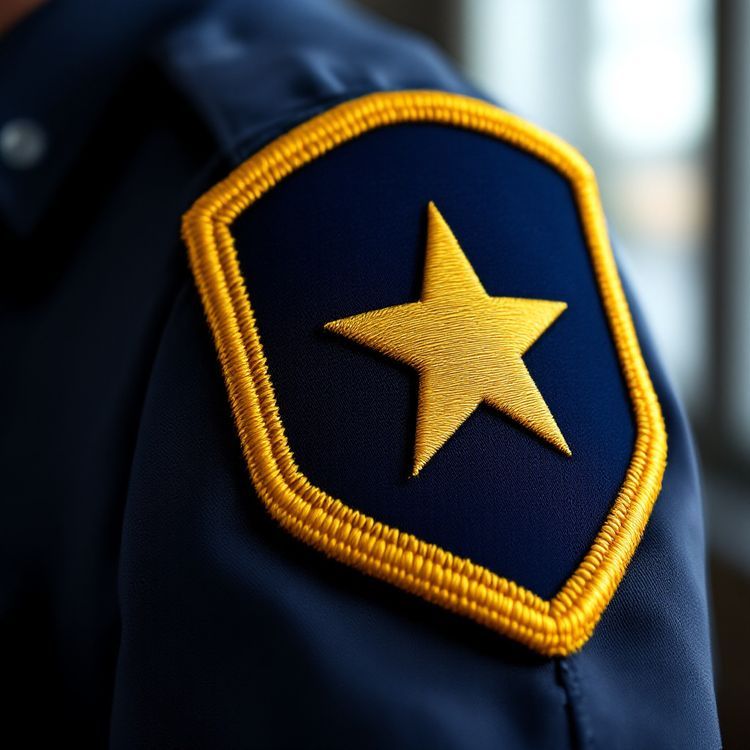
Special unit, rank and event patches
Beyond the standard shoulder patch, corrections agencies often order smaller runs for specific teams and occasions:
- Emergency response or tactical teams: subdued patches on hook-and-loop for vests and BDUs.
- K9 units: handler patches and vest patches for contraband detection teams. See our guide to K9 unit patches.
- Transport and court services: division tabs or rockers above the shoulder patch.
- Honor guard: metallic thread or hand embroidered bullion for formal uniforms.
- Academy classes: graduating class patches and challenge coins.
- Corrections Week: the first full week of May is widely observed as National Correctional Officers and Employees Week, a common time for commemorative patches, pins and coins.
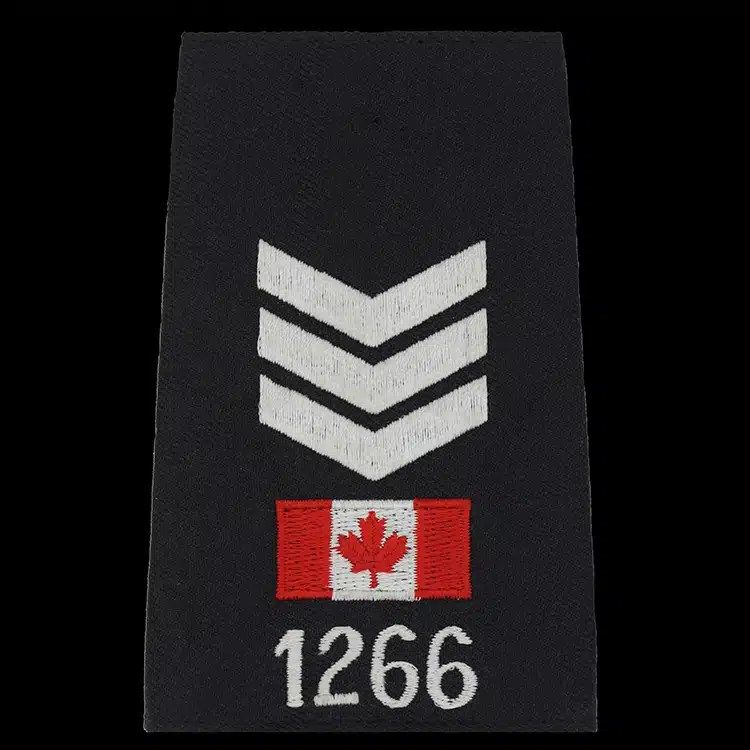
Rank on corrections uniforms is often shown on collar brass or epaulets rather than patches. If your supervisors wear epaulet covers, we make those too, with no setup or digitizing fees.
Backing choice for corrections uniforms
Class A and Class B shirts are usually sewn, since they are laundered constantly and a patch that lifts looks poor on a uniform. Hook-and-loop is common on tactical vests, jackets and BDUs, where teams swap patches between garments. Iron-on is fine for quick application on lighter items, but for uniforms most departments sew it down as well. Our comparison of patch backings walks through each option.
Keeping patches consistent over the years
A corrections shoulder patch can stay in service for a decade or more, and over that time small drifts creep in: a slightly different gold, a border that is a shade darker, a seal redrawn by a new vendor. Officers notice when two patches on the same shift do not match, and so do visitors and the courts.
The fix is simple. Keep one physical sample from every run in a labeled envelope, along with the spec sheet and the approved proof. When you reorder, send a photo of the most recent sample next to the spec, and say clearly if anything should change. If the agency name, a division or the seal is updated, treat it as a new design: approve a fresh proof rather than asking for small edits by email, so the change is recorded in writing.
It also helps to name one person in the department who owns the patch. Training officers change, budgets move between offices, and a patch that belongs to no one is the one that ends up reordered from an old photo.
Ordering and timing
Corrections orders tend to follow academy cycles, budget years and uniform changeovers. Plan backward from the date you need patches in hand:
- Quote: typically 2 to 3 business days after we have your specs and artwork.
- Proof: usually 1 to 3 business days after artwork, for approval in writing.
- Production: about 3 to 4 weeks after proof approval.
- Rush: around 10 business days when the factory can hold it.
- Minimum: custom runs from 100 pieces, varying by product, confirmed on the quote.
All timing is typical and confirmed on your quote. Many agencies order a year's worth of shoulder patches at once and keep stock for new hires. You can see the standard law enforcement patch options on our patches page, then send your specs for a quote.