Selling enamel pins well comes down to four things: a design your audience already wants, a unit cost you know before you set a retail price, packaging and photos that make a small item look worth buying, and a sales channel that suits you, whether that is your own online store, a marketplace, conventions or pop-up markets. Start with one strong design rather than a set, order enough to cover the factory minimum, and plan how you will ship before the pins arrive.
This guide is for artists, illustrators, small brands, bands and creators launching their first pins or tidying up a line that already sells. It focuses on the business side; for the artwork itself, see our step-by-step guide on how to design an enamel pin.
Choose a first design people already want
The safest first pin is a version of something your audience already responds to: your most popular illustration, a character that shows up in your work, an in-joke from your community, or your brand mark in a form people would wear. Look at which posts, prints or products have done best and start there.
- Pick one design that reads at a glance at about 1 to 1.5 in (25 to 38 mm).
- Check that every element is your own, or that you have a license for it. Fan art of trademarked characters is a legal risk on public marketplaces.
- Ask your audience: a quick poll between two sketches gives you a signal before you spend anything.
- Think about the series. A first pin that could become part of a set gives buyers a reason to come back.
Size matters for both cost and appeal. Most selling pins sit between about 1 and 1.75 in (25 to 44 mm). Our guide to enamel pin sizes shows how much detail each size can hold.
Choose the pin type with selling in mind
Soft enamel has recessed colour between raised metal lines, giving texture and depth, and it suits bright, playful designs. Hard enamel is filled level with the metal and polished smooth, which reads as more premium and resists scratching. Neither is better for selling in general; match the finish to your art and your buyers. Our comparison of soft vs hard enamel pins covers the differences in detail.
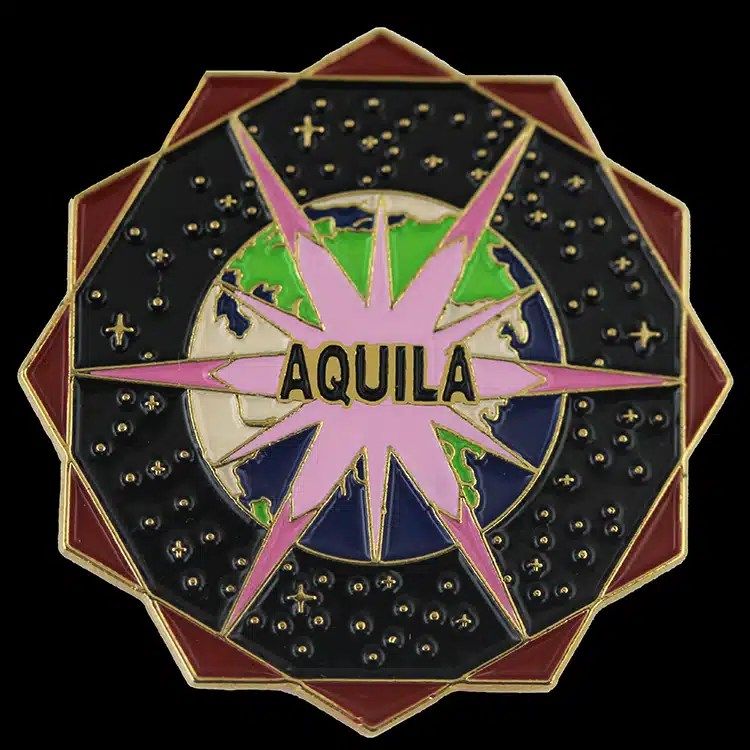
Small upgrades help a pin stand out: a backstamp with your logo on the reverse, two posts on a wider pin so it does not spin, glitter or translucent enamel in one area, or metal locking backs that collectors prefer over rubber clutches. Each upgrade affects the factory price and not every one suits every pin, so ask on the same quote which of them your run can carry and decide from there. Our guide to pin backs explains the choices.
Work out your real unit cost
Before you set a retail price, add up everything a single pin costs you to sell. The factory price on your quote is only the start.
| Cost | What it covers | Notes |
|---|---|---|
| Production | Pins, setup and any upgrades | From your quote, divided by quantity |
| Backing cards | Printed card each pin sits on | Ordered from a print shop |
| Packaging | Sleeves, mailers, stickers | Rigid mailers protect posts in the post |
| Selling fees | Platform, payment and listing fees | Varies by channel |
| Shipping | Postage you absorb or pass on | Decide before launch |
| Losses | Damaged or unsold pins, giveaways | Plan for a few |
Divide the total by the number of pins you expect to sell, not the number you ordered. Then look at what similar pins from creators of your size sell for, and set a price that covers your cost with a margin you are comfortable with. Larger quantities bring the per-piece production cost down, which is why many sellers reorder a proven design in bigger runs.
Packaging and product photos
A pin on a printed backing card looks like a finished product. The card carries your brand, the pin name, and space for an edition note or a social handle. Punch two holes for the posts and use clutches to hold the pin firmly. For shipping, a pin in a cello sleeve inside a rigid mailer survives far better than one in a plain envelope.
Photos sell pins online. Shoot each pin on its card and on a jacket, bag or hat so buyers can see the scale, and take a close-up that shows the metal finish. Natural light and a plain background beat a busy desk. When the shipment arrives, check pins before you list them; set aside any with flaws as seconds rather than mixing them into the main stock.
Where to sell enamel pins
Most sellers end up using two or three channels. Each has trade-offs:
- Your own online store: you keep control of branding and customer emails, but you have to bring the traffic yourself.
- Online marketplaces: built-in shoppers who search for pins, with fees and more competition on every listing.
- Conventions and fairs: high sales per hour for the right audience, and pins are an easy impulse buy at a table. Display boards and banners help; our guide on displaying enamel pins has layouts that work.
- Local shops on consignment or wholesale: steady, smaller sales in stores that suit your style.
- Bundles: a pin alongside a print, a shirt or a patch raises the order value for buyers who already like your work.
Patches are a natural second product line for pin sellers, since collectors often wear both. Our comparison of patches vs pins for merch helps decide what to add next.
Limited editions and variants
Collectors respond to scarcity, so many sellers release some pins as limited editions. A limited edition is simply a run you promise not to repeat, sometimes numbered on the backing card. Only call a pin limited if you mean it; reissuing a limited design later damages trust with the buyers who paid for it. Variants, such as the same design in a different metal colour or with glitter added, let you offer something new without designing from scratch, though each variant is listed separately on the quote.
Launch, then reorder what sells
Plan your launch around the production timeline: a quote within 2 to 3 business days, a proof 1 to 3 business days after artwork, and about 3 to 4 weeks of production after you approve the proof in writing, all typical and confirmed on the quote. Announce early and share the proof stage with your audience; it builds interest before stock arrives.
When a design sells through, reorder it. Reorders skip the setup, and the molds stay on file, so a proven pin costs less to restock than a new one costs to launch. When you are ready, browse our custom lapel pins and send your artwork for a quote.