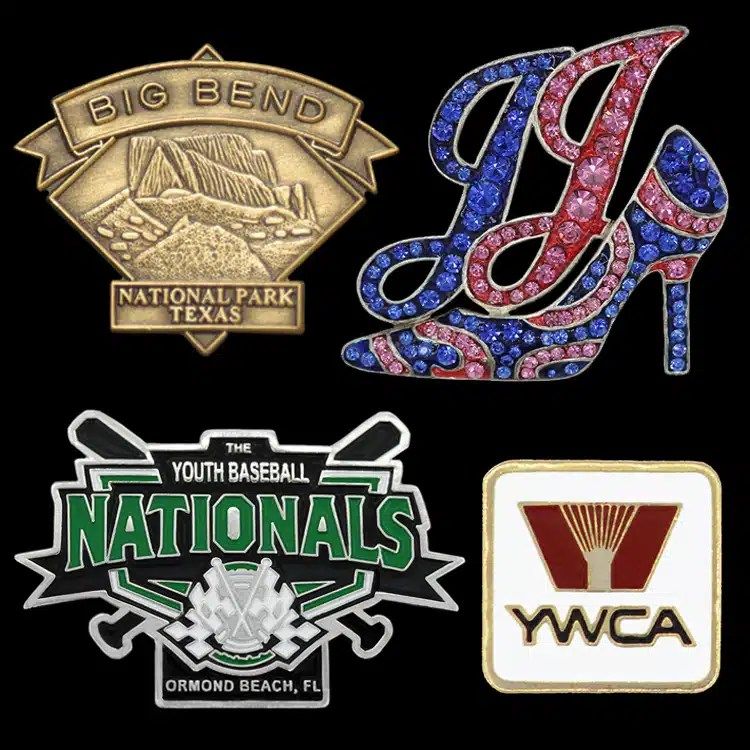
The most common enamel pin size is about 1 in (25 mm), measured across the widest point. A traditional lapel pin worn on a suit is about 3/4 to 1 in (19 to 25 mm), most event, brand and collector pins fall between 1 and 1.5 in (25 to 38 mm), and trading pins and statement pins run 1.75 to 2.5 in (44 to 64 mm) or more. Pick the smallest size that still holds your smallest text and details clearly.
This guide explains how pin size is measured, what fits at each size, how size affects the back and the price, and how to test a size before you order.
How enamel pin size is measured
Pin size is the measurement of the longest side. A round pin is its diameter. A pin that is 1.25 in wide and 0.8 in tall is quoted as a 1.25 in pin. A tall, narrow pin is measured by its height.
That matters for shapes. A long, thin wordmark at 1.25 in has much less usable area than a 1.25 in circle, so the text inside it will be smaller. When you compare sizes, think about the shape of your design, not just the number.
On a quote, give the overall width and height, or the diameter for a round pin. If you are unsure, give the size you want for the longest side and we will work out the other dimension from your artwork.
Enamel pin size chart
These are general guidelines. The right size depends on your artwork, the construction and how the pin will be worn.
| Size | Typical use | What fits |
|---|---|---|
| 3/4 in (19 mm) | Suit lapel, service pins, small logo pins | A simple icon or monogram, very little text |
| 1 in (25 mm) | The all round default for brand, staff and event pins | A logo with a short word or two |
| 1.25 in (32 mm) | Merch, collector and school pins | A logo plus a short line of text |
| 1.5 in (38 mm) | Collector and event pins, hat and bag pins | An illustration with some detail and a name |
| 1.75 to 2 in (44 to 51 mm) | Trading pins, statement pins | Team name, year, mascot and location |
| 2.5 to 3 in (64 to 76 mm) | Large trading pins and showpieces | Detailed art and add-ons such as spinners or danglers |
Choosing size by how the pin is worn
Suit lapels and uniforms
A pin on a suit lapel or a uniform should look discreet. About 3/4 to 1 in (19 to 25 mm) is the traditional range for service, rank and company pins. Larger pins tend to look like novelty pieces on formal clothing.
Hats, bags and jackets
Pins on a cap, a backpack strap or a denim jacket are seen from further away and compete with the fabric around them. About 1.25 to 1.5 in (32 to 38 mm) is a common choice. A cap front often suits something narrower so the pin does not sit over the brim curve.
Collector and merch pins
Pins sold as merchandise are often 1.25 to 1.75 in (32 to 44 mm). That gives enough room for an illustration while keeping the pin wearable. Collectors tend to like a consistent size across a series so the pins line up on a board or banner, which our guide on how to display enamel pins covers.
Trading pins
Youth baseball and softball trading pins are usually larger, often 1.75 to 2.5 in (44 to 64 mm), so they can carry the team name, the state, the year and a mascot. See our trading pins guide for the details.
How size limits detail
Every enamel colour sits in its own cell, separated from its neighbors by a raised metal line. Those lines and cells have practical minimum sizes, so a design that looks fine on screen can lose detail when it is shrunk to a small pin.
- As a rule of thumb, keep text at about 1/16 in (1.5 mm) tall or larger on a struck enamel pin, and larger still for thin or script fonts.
- Raised metal lines need a minimum width to strike and plate cleanly, roughly 0.3 mm (0.012 in) as a general guide.
- Very small enclosed areas of colour may be dropped or merged into a neighboring colour.
- Long names around a ring need more diameter than the same name in a straight line.
If your artwork has fine lettering or hairline detail you cannot give up, a photo etched pin holds finer lines than a struck die, and a printed pin can carry small text in full colour. Our guide on how to design an enamel pin covers detail limits in more depth.
Size, posts and pin backs
Small pins sit fine on a single post with a butterfly or rubber clutch. As pins get larger, they get heavier and are more likely to spin around one post. Pins larger than about 1.5 in (38 mm) are often made with two posts so they stay straight, and very large or heavy pins may suit a locking clutch so they are not lost.
If the pin will go on a uniform that should not be pierced, a magnetic back is an option, but a large, heavy pin on a thin magnet can slide. Ask us when you quote. Our guide to lapel pin backs explains each option.
How size affects cost
Size is one of the biggest drivers of a pin's cost, along with the construction, the quantity, the number of colours, the plating and any add-ons. Larger pins use more metal and enamel and take a larger die. Going from 1 in to 1.5 in is a meaningful change in material, not a small one.
We do not publish prices. Every job is quoted from the factory price, so the useful step is to ask for two sizes on the same quote. That shows you the difference for your actual design and quantity, and you can decide whether the extra size is worth it.
Choosing your size and getting a quote
- Decide how the pin will be worn: lapel, uniform, hat, bag or board.
- Find the smallest element in your art, usually the text, and check it at the size you have in mind.
- Print it at size and test it on the real garment.
- If you are between two sizes, ask for both on one quote.
You can see the constructions we run on our lapel pins page. When you are ready, send the artwork for a quote with the size, quantity, construction, plating, back and in-hands date. Custom minimums start from 100 pieces and are confirmed on the quote, and you approve a proof at the final size before anything is made.