To order custom lapel pins you need to settle six things: the construction (hard enamel, soft enamel, die struck, photo etched or printed), the plating and finish, the size, the pin back, the quantity and the date you need them in hand. Get those right and the quote is accurate the first time. For most organizations, a soft enamel pin about 1 in (25 mm) with gold or silver plating and a butterfly clutch is the sensible starting point.
This guide goes through each decision in the order you need to make it, with the trade-offs and the questions to ask.
Start with what the pin is for
The purpose of the pin narrows most of the later choices, so settle it first. A few common cases:
- Service and recognition pins are worn on a jacket for years. They usually suit hard enamel or die struck metal, a small size and a secure back.
- Brand and staff pins are worn on uniforms and lanyards. Soft enamel at about 1 in (25 mm) is a common fit.
- Event and giveaway pins need to look good in a photo and fit the budget. Soft enamel or a printed pin works well.
- Merch and collector pins are sold, so the art matters most. Larger sizes and specialty add-ons are more common here.
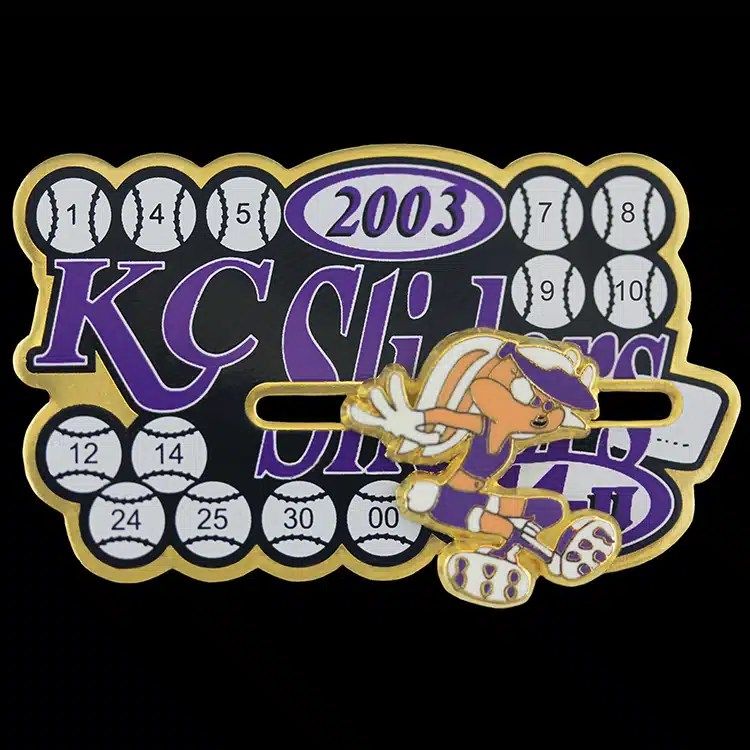
- Trading pins for youth baseball and softball are big, bright and often built up with moving parts.
If you know who will wear the pin, where and for how long, the right construction, size and back usually follow.
The seven pin constructions
Every metal pin starts with a die cut from your artwork, struck into brass or steel. What happens next decides the look.
| Construction | How it looks | Best for |
|---|---|---|
| Cloisonne hard enamel | Enamel polished flush with the metal, smooth and glossy | Service, rank and anniversary pins |
| Die struck soft enamel | Colour sits below raised metal lines, textured | Event, brand and team pins |
| Die struck without enamel | Plated metal only, sculpted relief | Formal, classic and monochrome designs |
| Photo etched | Fine detail etched into brass, soft enamel fill, epoxy dome | Small lettering and fine linework |
| Silkscreened | Full colour printed on a flat metal face | Detailed full colour logos on a flat pin |
| Offset printed | Photographic print under a clear epoxy dome | Gradients and photo art |
| Specialty | Spinners, blinkers, danglers and built up pieces | Trading pins and novelty pins |
For most buyers the real choice is between soft and hard enamel. Soft enamel has depth and texture and generally costs less. Hard enamel is smooth, more formal and resists chipping. Our comparison of soft and hard enamel pins covers that decision in detail, and die struck vs enamel pins covers the no-colour option.
Plating and finish
Every metal construction is plated. The plating is the colour of the raised metal lines, the outline and the back, so it affects the whole look.
- Gold is the traditional choice for awards and formal pins, and it warms up most enamel colours.
- Silver and nickel read cooler and suit blue, black and gray palettes.
- Copper is an option for a warmer, vintage look.
The finish then sets the surface. A polished finish is bright and reflective. An antique finish darkens the recessed areas so the raised detail stands out, which suits die struck pins without enamel. A sandblasted finish gives a matte texture, often used as a background behind polished raised lines for contrast.
If your design has dark enamel colours, choose a bright plating so the metal lines separate the colours. Black nickel on navy enamel, for example, can make the outline disappear.
Choosing a pin size
Size is measured across the widest point. As a rule of thumb, a traditional lapel pin worn on a suit is about 3/4 to 1 in (19 to 25 mm). Event and brand pins often run 1 to 1.5 in (25 to 38 mm). Trading pins and collector pins are larger again. Size drives cost and detail: a bigger pin can hold more text and smaller shapes, but it costs more to make.
Our guide to enamel pin sizes gives a full size chart with what fits at each size.
Pin backs
The back decides how the pin stays on and how it is worn.
- Butterfly clutch: the standard metal clutch, secure and inexpensive, right for most pins.
- Rubber clutch: softer, easy to grip, a common choice for kids and trading pins.
- Deluxe locking clutch: locks onto the post so valuable pins are harder to lose.
- Magnet: for uniforms and garments that should not be pierced.
- Safety pin: for quick attachment to fabric, lanyards and ribbons.
Pins larger than about 1.5 in (38 mm) often use two posts so they do not rotate. Our guide to lapel pin backs explains each type and when to choose it.
Artwork and colour
Vector artwork (AI, EPS or PDF) gives the cleanest die and the truest colour match. A PNG or a photo of an existing pin is enough to start, and we will confirm what is achievable on your quote.
Enamel colours are solid fills matched to your references, usually Pantone numbers. Each colour sits in its own cell separated by a metal line, so very small areas of colour and gradients do not work in enamel. If your art depends on a gradient or a photograph, an offset printed or silkscreened pin is the better fit. Our guide on how to design an enamel pin covers line widths, text size and colour count in detail.

Quantity, minimums and timing
Custom pin minimums are set per job, from 100 pieces, and confirmed on your quote. A die is cut for every new design. Mold charges for a die struck pin without enamel are the same as for die struck soft enamel, and the exact amount appears on your quote. Reorders of the same design skip that setup because the die stays on file.
Typical timing, confirmed on your quote:
- Quote within 2 to 3 business days.
- Proof usually 1 to 3 business days after artwork.
- Production about 3 to 4 weeks after you approve the proof in writing.
- UPS shipping from Holly Hill, Florida.
Rush production of around 10 business days is sometimes possible when the factory can hold it. Ask when you quote if your date is tight.
What to send for a quote
- Size, as overall width and height or the diameter.
- Quantity, and whether you need more than one design or size.
- Construction, or the look you want so we can suggest one.
- Plating, finish and the number of enamel or print colours.
- The pin back.
- Artwork and the in-hands date.
You can see every construction and finish on our custom lapel pins page. When you have the details, request a quote. We price each job from the factory price, and nothing runs until you approve the proof in writing.