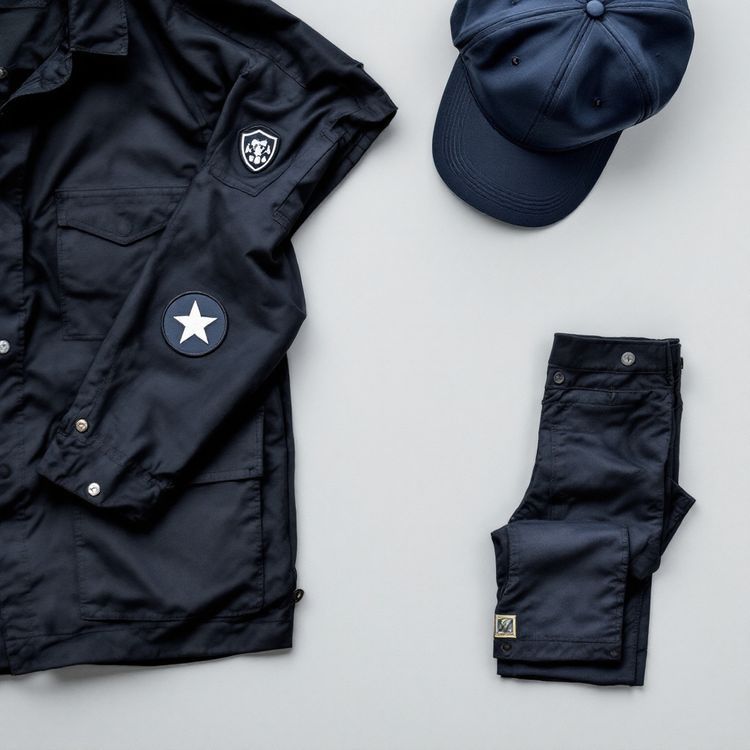
The standard patch placement on a shirt or polo is the left chest for the logo, the right chest for a name, and the upper left sleeve for a shoulder patch. As a rule of thumb, center a left chest patch about 3.5 to 4 in (89 to 102 mm) from the center of the placket and set its top about 7 to 9 in (178 to 229 mm) below the high point of the shoulder, where the collar meets the shoulder seam. A shoulder patch sits about 1 in (25 mm) below the shoulder seam. Those measurements, applied the same way on every size, are what make a team's shirts look matched.
Below we go through each placement with sizes, how to adjust for small and large shirts, polo-specific details, and how to mark a batch of shirts so they all come out the same.
Left chest: the main logo
The left chest is the most common spot for a company, club or team logo, because it sits over the heart and is the first place people look. On a shirt with a pocket, the patch goes centered on the pocket, or just above it if the pocket has a flap. On a polo or a shirt without a pocket, measure:
- Across: center the patch about 3.5 to 4 in (89 to 102 mm) from the center of the placket on an adult medium, a little less on small sizes and a little more on XL and up.
- Down: put the top of the patch about 7 to 9 in (178 to 229 mm) below the high point of the shoulder. A quick check: the patch should sit roughly level with the second or third button of the placket.
Left chest patches are usually about 3 to 4 in (76 to 102 mm) wide. Wider than that and they start to wrap into the armhole. Our patch size guide compares sizes for each placement.
Right chest: names, titles and second logos
The right chest mirrors the left chest. It is where work shirts carry a name patch, and where uniforms carry a title, a department name, or a second logo such as a partner brand or certification. Use the same measurements from the placket and shoulder as the left side, so the two patches sit level across the chest. A name patch is commonly a rectangle or oval about 3.5 to 4 in (89 to 102 mm) wide and 1.5 to 2 in (38 to 51 mm) tall. See our guide to custom name patches for lettering sizes.
Sleeves: shoulder patches and flags
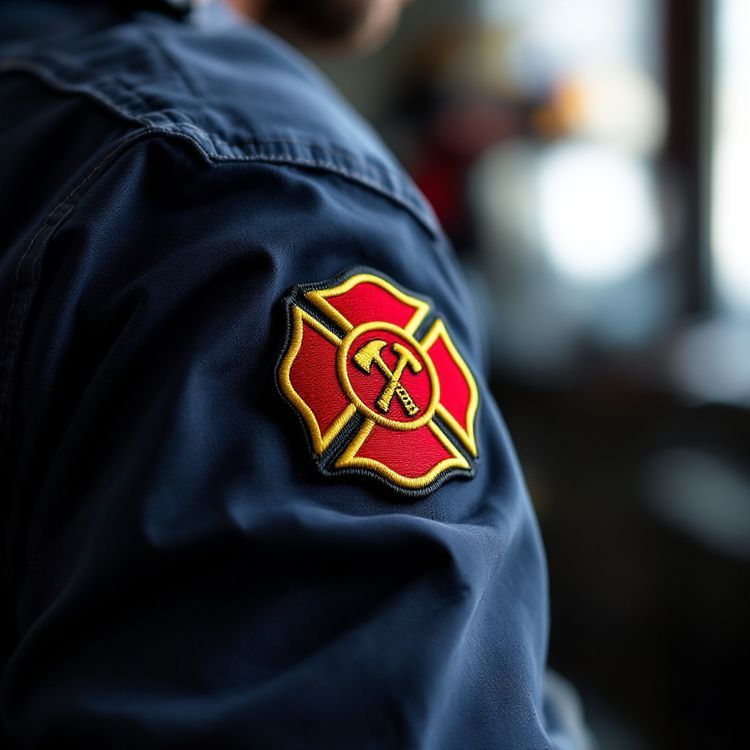
Uniform shirts carry shoulder patches on the upper sleeve. The usual placement is centered on the outside of the sleeve, with the top of the patch about 1 in (25 mm) below the shoulder seam. On police, fire and EMS shirts the department patch typically goes on the left sleeve, often on both. Agencies usually have their own uniform policy, which takes priority over any general guide.
A US flag patch is usually worn on a sleeve. Which way it faces depends on the sleeve; our American flag patch guide explains orientation.
On a polo, the sleeve is short, so keep a sleeve patch to about 2.5 to 3 in (64 to 76 mm) and leave space above the sleeve hem.
Back, yoke and other spots
- Back yoke: a small logo or a wordmark centered just below the collar, about 2 to 3 in (51 to 76 mm) below the collar seam. Common on work shirts and staff shirts.
- Full back: a large patch centered on the back, usually on jackets and work shirts rather than polos.
- Pocket flap: small patches, pins or tabs.
- Lower front hem: a small brand patch near the hem on the left front, used more by clothing brands than by teams.
Women’s and fitted cuts
On fitted and women’s shirts, the chest is shaped by darts or curved seams, so the same measurements can put a patch too low or too far out. Move a left chest patch slightly higher and closer to the placket, and size it down by about 1/4 to 1/2 in (6 to 13 mm). Check it on a person rather than flat, because a fitted shirt changes shape more when worn. For a mixed team, keep the patch the same and adjust only its position, so the logo still matches across the roster.
Shirt patch placements at a glance
| Placement | Typical use | Typical size | Measure from |
|---|---|---|---|
| Left chest | Company or team logo | 3 to 4 in (76 to 102 mm) wide | About 3.5 to 4 in from placket, top 7 to 9 in below shoulder |
| Right chest | Name, title, second logo | 3.5 to 4 in (89 to 102 mm) wide | Mirror of the left chest |
| Upper sleeve | Department patch, flag | 3 to 4.5 in (76 to 114 mm) tall | Top about 1 in below shoulder seam |
| Polo sleeve | Small logo or flag | 2.5 to 3 in (64 to 76 mm) | Centered on the outside of the sleeve |
| Back yoke | Wordmark, small logo | 3 to 5 in (76 to 127 mm) wide | About 2 to 3 in below collar seam |
Polo-specific details
Polos are knit pique, which stretches more than woven shirting, and they have a short placket and no pocket.
- Keep the left chest patch smaller than on a work shirt, about 3 to 3.5 in (76 to 89 mm) wide, so it does not drag the knit.
- Sew rather than iron where you can. Pique has a textured surface that gives iron-on adhesive less to grip, and many performance polos are polyester, which does not like heat.
- Choose a thinner, more flexible patch. Woven patches sit flatter on knit than heavy, fully stitched embroidery.
Marking a batch so every shirt matches
- Lay a medium shirt flat, buttoned, and mark the ideal position with chalk.
- Cut a cardboard template: a strip with a notch at the shoulder point and a window at the patch position.
- Use the template on every shirt of that size. Make a second template for small sizes and a third for 2XL and up.
- Pin or tape each patch, then try on one shirt per size before you sew or press the batch.
For a full uniform rollout, our guide to patches for business uniforms covers sizing a roster and ordering spares.
Ordering shirt patches
Tell us the shirt type (work shirt, polo, uniform shirt), the placements, and how the patches will be attached when you request a quote. Our corporate and uniform patches come with sew-on, iron-on or hook-and-loop backing. Quotes come back in about 2 to 3 business days, and nothing runs until you approve the proof in writing.