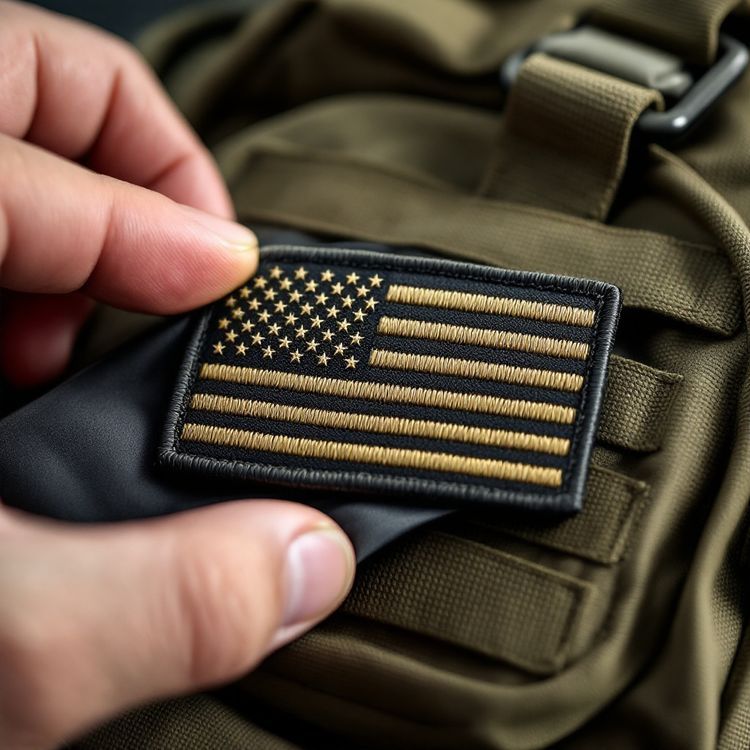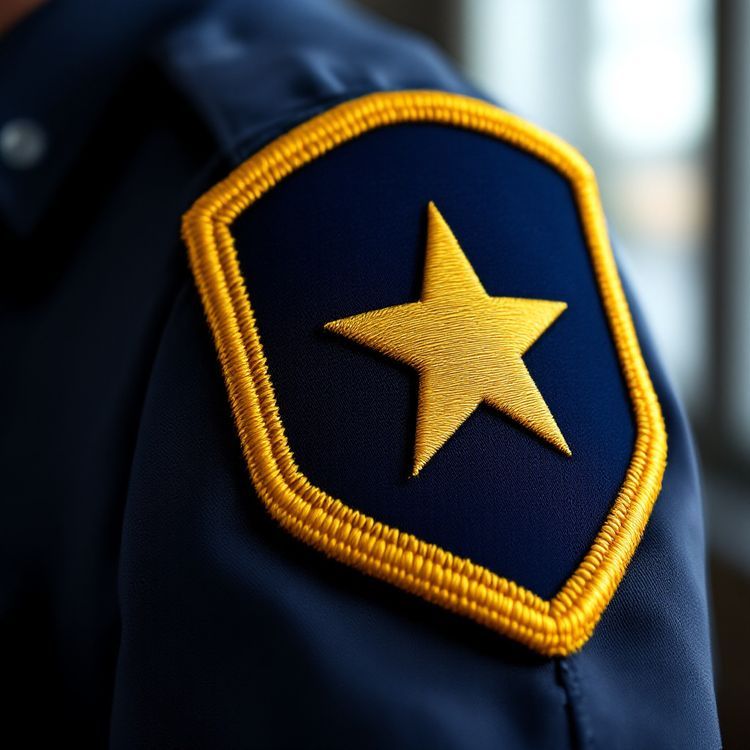
The common rule for shoulder patch placement is to center the patch on the outside of the sleeve with its top edge about 1/2 in (13 mm) to 1 in (25 mm) below the shoulder seam. The patch should line up with the center of the arm when the wearer stands with arms relaxed, not with the crease of a folded sleeve. Your agency, department or service may publish its own measurement, and where it does, that rule wins over any general guide, including this one.
Below we cover how to find the center line, which sleeve gets which patch, how tabs and rockers stack, and how to keep placement identical across a whole roster.
The basic rule, measured properly
Two measurements set a shoulder patch: how far down the sleeve it sits, and where it sits across the sleeve.
- Vertical: measure from the shoulder seam (where the sleeve joins the body) straight down to the top edge of the patch. About 1/2 in (13 mm) is common on uniform shirts. Some organizations use 3/4 in (19 mm) or 1 in (25 mm), especially on outerwear with a heavier seam.
- Horizontal: center the patch on the outer sleeve. The simplest way is to find the point on the shoulder seam directly above the middle of the arm and run an imaginary line down from it.
When a tab or rocker sits above the patch, the measurement usually applies to the top of the tab, with the patch below it. Check your own standard on this, because some specify the patch position and let the tab sit above.
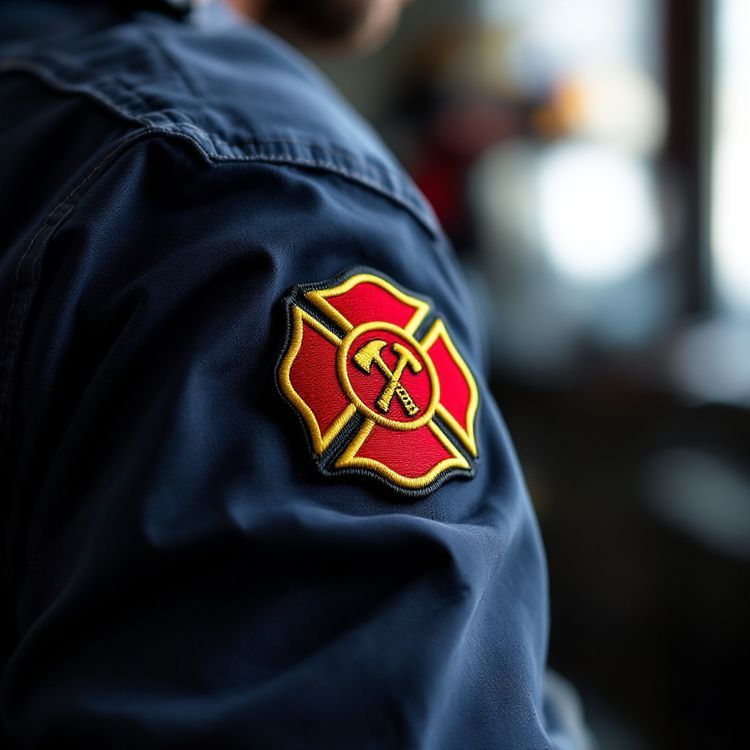
How to find the center of the sleeve
Folding a sleeve in half and centering the patch on the fold is a common shortcut, but it can put the patch toward the front or back of the arm, because many sleeves are cut with more fabric at the back. A better method:
- Put the shirt on a person or a shaped hanger, buttoned, so the sleeve hangs as it does when worn.
- Have the wearer stand relaxed, arms at their sides.
- Look at the arm from directly to the side. Mark the point on the shoulder seam that sits over the middle of the arm with a pin or chalk.
- Measure down from that mark to where the top of the patch will go and pin the patch centered under it.
- Check from the side and from slightly in front. The patch should look level, not tilted toward the chest.
Once you have the position right on one shirt of each style, make a template so you do not have to repeat the fitting for every garment.
Which sleeve gets which patch
There is no single national rule for civilian uniforms. Common arrangements are:
| Arrangement | Left sleeve | Right sleeve | Seen in |
|---|---|---|---|
| Same patch both sleeves | Agency or company patch | Agency or company patch | Many police, fire and EMS departments |
| Patch and flag | Agency patch | US flag patch | Some public safety and security uniforms |
| Single patch | Agency or company patch | Plain | Work uniforms, clubs, volunteer groups |
| Patch and specialty | Agency patch | Unit or specialty patch | Teams such as K9, SWAT or rescue units |
When a US flag patch is worn on the right sleeve, it is commonly a reversed field version so the stars face forward, as if the flag were flying as the wearer moves. Our American flag patches guide explains orientation in more detail.
Military uniforms
Each service sets placement in its own uniform regulation. For the Army, for example, that is AR 670-1 and its companion pamphlet DA Pam 670-1, and on current combat uniforms the unit patch and flag attach to hook-and-loop areas on the sleeves rather than being sewn to a measurement. Follow the current regulation for your branch rather than a general guide, and do not copy official insignia without authorization from the relevant authority.
Tabs, rockers, rank and other sleeve items
Shoulder patches often share the sleeve with other items. A general order from top to bottom, where your standard does not say otherwise:
- Tab or rocker: a curved or straight strip above the patch, such as a unit name, a specialty or a state. Sit it close to the patch, usually with a gap of about 1/8 in (3 mm) or touching, and centered on the same line.
- Shoulder patch: the agency or organization emblem.
- Rank chevrons: often centered below the patch, with a small gap, on the sleeves where rank is worn.
- Service stripes or hash marks: usually on the lower sleeve, not near the shoulder patch.
Rank, stripes and specialty insignia are where organizations differ most, so check your own written policy. Our guides on police and sheriff patch design and fire department patches cover patch sizes that suit sleeve placement.
Patch size and sleeve fit
Shoulder patches on adult uniforms commonly run about 3.5 in (89 mm) to 4.5 in (114 mm) on the longest side. A patch that is too wide wraps around the arm and is hard to read from the side. If your roster includes short sleeves, small sizes or female cut shirts with narrower sleeves, check the patch against the narrowest sleeve before you finalize the size.
Our patch size guide shows common sizes by placement, and the police and public safety patches section shows typical shoulder shapes.
Jackets, outerwear and short sleeves
Jackets have heavier shoulder seams and often a dropped shoulder, so a measurement taken from the seam can put the patch too low. On jackets, check the patch against the shirt patch with both garments on, and adjust the distance so the two sit at about the same height on the arm. On raglan sleeves, where the seam runs diagonally to the neck, measure down from the highest point of the shoulder instead. On short sleeves, make sure the bottom of the patch, and any rank below it, sits clear of the hem with room to spare.
Keeping placement consistent across a roster
The most common complaint about shoulder patches is that they sit at different heights on different people. A few habits fix that:
- Write the placement standard down: distance below the seam, how to find the center, and which sleeve gets which patch.
- Cut a template from card or clear plastic with a notch for the shoulder seam and a window for the patch. Whoever sews or presses uses it every time.
- Send the written standard to any outside tailor or uniform supplier who attaches patches for you.
- Check new uniforms on arrival before they are issued.
For a new or redesigned shoulder patch, send us the artwork, size and quantity and we will send a quote, typically within 2 to 3 business days. Nothing is made until you approve the proof in writing, and reorders skip setup so later batches match.