Robotics team patches work best when they are built around your team number and logo, sized at about 3 to 4 in (76 to 102 mm) for shirts and jackets, and made as embroidered or woven patches depending on how much detail the logo carries. Most teams pair them with small soft enamel pins for trading at competitions and a printed lanyard for pit badges. Order early enough that everything arrives before your first event, since the season moves fast once it starts.
This guide covers designing for a robotics or STEM team, picking the right patch construction, trading pin basics, using sponsor and program logos properly, and the timing that keeps a build season on track.
Design around your team number
In most robotics leagues the team number is how judges, referees, other teams and announcers know you. Treat it as the main element of the design, not an afterthought. A patch that shows a clever robot drawing but hides the number in small type misses the point at a crowded event.
- Make the number the largest text on the patch, in a bold, simple font.
- Add the team name as a second line, and the school, club or city only if it fits at a readable size.
- Keep the mascot or robot art to bold shapes and four to six colours.
- Leave sponsor names off the main patch. A separate sponsor patch or the back of a shirt is a better home for them.
- Avoid the season's game logo unless you have confirmed you may use it, and leave the date off the main patch if you want to reuse it next year.
A circle, shield or hexagon with a merrowed border is the easiest shape to read and the most economical to produce. Gear and bolt outlines look great, but a heat cut edge around fine gear teeth can lose detail at small sizes, so keep the teeth chunky.
Involve students in the design, but give them the constraints first: the size, the colour limit and the smallest readable lettering. A design brief turns the patch into a small engineering problem, which tends to suit robotics students well. Ask for two or three options, preview each at actual size, and let the team vote. A printed copy at real size held against a shirt is the quickest test of whether the number reads from a few feet away.
Which patch construction suits a STEM team
STEM logos often include circuit traces, thin outlines, small lettering or gradients from a 3D render, so the construction choice matters more than usual.
| Logo style | Best construction | Why |
|---|---|---|
| Bold number and simple mascot | Embroidered | Raised, durable, classic team look |
| Circuit traces, fine lines, small text | Woven | Holds thin lines and small lettering |
| 3D robot render, gradients, photo | Sublimated | Prints full colour and soft shading |
| Large lettering on a team jacket back | Satin tackle twill | Covers a big area while staying light |
If your logo has fine traces, a woven patch keeps them sharp where embroidery would merge them. If the team has already made a polished render of the robot, a sublimated patch can reproduce it. For anything in between, try your file in the free Patch Studio at the size you need and compare embroidered and woven side by side.
Backings for team gear
For team shirts and polos, sew-on or iron-on backing both work; iron-on is quicker when students apply their own. For backpacks, team jackets and caps where you want to swap a season patch each year, hook-and-loop backing lets you change the patch without unpicking stitches. Drive team members who wear the same jacket across several seasons often like this option.
Trading pins at competitions
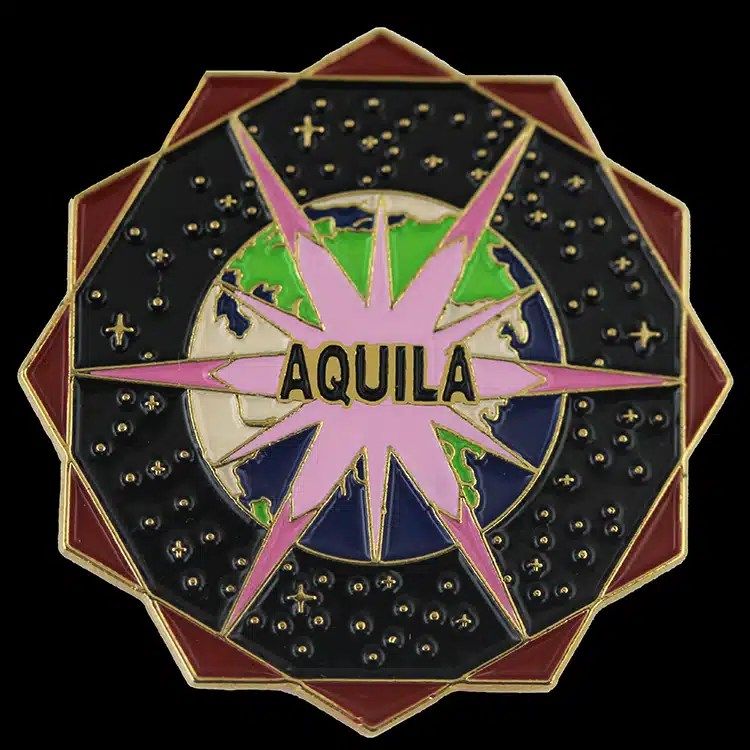
At many robotics events, students trade pins with other teams in the pits and stands, and a good team pin is an easy way to meet people. Trading pins are usually soft enamel, around 1 to 1.5 in (25 to 38 mm), with the team number large on the face. Soft enamel keeps the cost per piece practical at the quantities teams trade, and the recessed colour still reads well at that size.
Plan quantity by the number of events and students, and add extras for sponsors, mentors and new members. Rubber or butterfly clutch backs are standard for trading; see our lapel pin options for shapes, finishes and add-ons. Our trading pins guide was written for baseball and softball teams, but the advice on sizing and quantities carries over well.
Sponsor and program logos
Sponsors fund a large share of most robotics teams, and they appreciate seeing their logo on team gear. Ask each sponsor for an official vector file and for their brand rules, since many companies specify colours and clear space around the mark. A dedicated sponsor patch or a printed list on the back of a team shirt usually looks cleaner than crowding logos onto the main emblem.
Competition program names and logos are trademarks owned by the organizations that run them. Most publish guidelines on how teams may use their marks on merchandise. Read those guidelines, and if they require permission, get it in writing before you send artwork. The same applies to school logos and mascots, which are often controlled by the district.
Lanyards, coins and awards
Printed lanyards in team colours hold pit badges and safety credentials at events. Around tools and moving robots, a breakaway lanyard is worth considering, since the safety release lets go if the strap catches. Challenge coins make a lasting thank-you for mentors and sponsors at the end of a season, and custom medals suit school or district STEM fairs and in-house build competitions. Patches and pins also sell well at school events, which is how many teams cover travel costs; our guide to fundraising patches shows how to plan a run that pays for itself.
Timing your order around the season
Robotics seasons often start with a short, intense build period, which is the worst time for students to manage an order. Settle the logo and team number design in the off-season, and order patches, pins and lanyards before the build starts if you can. Allow 2 to 3 business days for the quote, about 1 to 3 business days for the proof after we have your artwork, and roughly 3 to 4 weeks of production after you approve it, plus shipping. A rush of around 10 business days is sometimes possible when the factory can hold it, and the custom minimum starts from 100 pieces, confirmed on your quote.
When you are ready, send us your artwork, your team number, sizes, quantities and your first event date. Nothing is made until a mentor or team lead approves the proof in writing, and reorders skip the setup, so next season's patch can be a quick repeat.