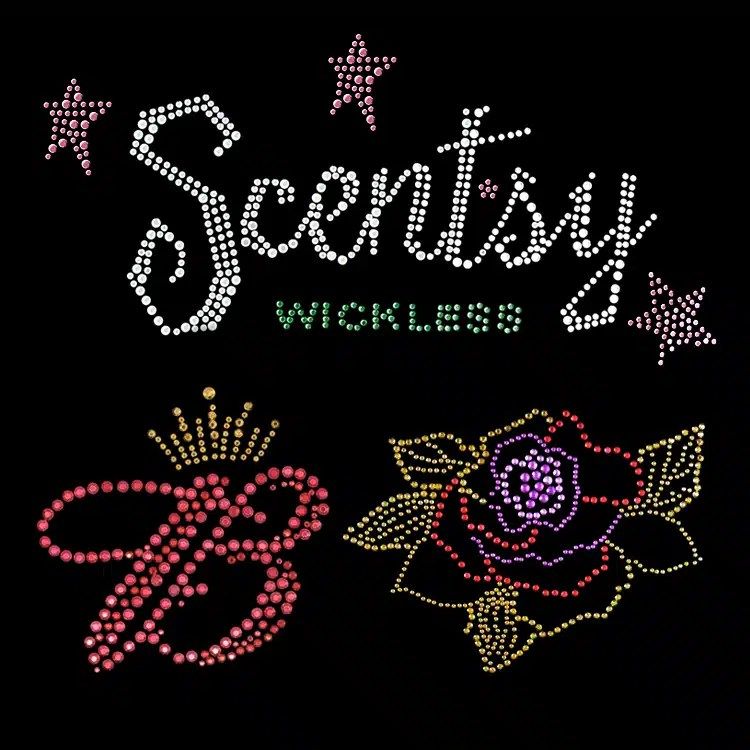
Rhinestone transfers are designs made of individual rhinestones, each backed with heat-activated glue and held in position on a clear, sticky carrier sheet. You place the sheet on a garment, press it with heat, and peel the carrier away, leaving the stones bonded to the fabric. They suit script names, monograms, logos and simple icons on team wear, cheer and dance uniforms, boutique apparel and event shirts. Bold outlines with a limited colour count work best, since every line of the design is built from stones.
Our custom rhinestone transfers are sold as StudStone heat transfers. This guide covers how they are made, how to design for them, which fabrics take them well and what to include when you request a quote. When the transfers arrive, our guide on how to apply rhinestone transfers takes you through pressing them.
How a rhinestone transfer is made
Your artwork is converted into a stone layout: a file that places every stone at a set position, size and colour along the lines and fills of the design. A template is cut from that layout, the stones are brushed into the template so each one drops into its own hole, and a sticky clear transfer tape is laid over the top to lift them out together, already in position.
The back of each stone carries a layer of hot fix glue. When you press the transfer, the glue melts into the fibers of the fabric and grips as it cools. That is why the transfer needs heat, pressure and time together: each one helps the glue reach into the weave.
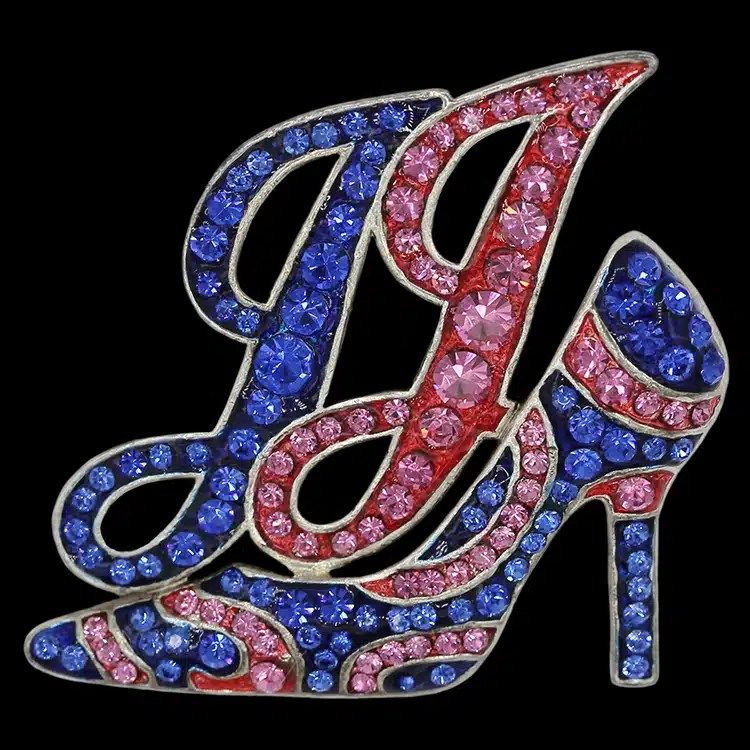
Because the design is a pattern of dots rather than solid colour, a rhinestone transfer looks different from a printed or embroidered design. Lines read as a row of sparkling points, and solid areas read as a field of stones. Designing with that in mind is the key to a good result.

Stone sizes and colours
Rhinestones are sized on the SS scale. As a general guide, SS6 is about 2 mm, SS10 about 2.8 mm, SS16 about 4 mm and SS20 about 4.8 mm across. Small stones hold finer outlines and smaller lettering; larger stones give more sparkle and fill large areas quickly. Many designs combine two sizes, with small stones for detail and larger ones for fills or accents.
Stones come in a wide range of colours, including clear crystal, gold and silver tones, and bright colours such as pink, red, blue and green. Each colour is a separate stone, so a design with five colours means five sets of stones placed by hand into the template. As with thread on patches, fewer colours usually look cleaner.
| Stone size | Approximate diameter | Good for |
|---|---|---|
| SS6 | About 2 mm | Fine outlines, small accents |
| SS10 | About 2.8 mm | Lettering, outlines, most designs |
| SS16 | About 4 mm | Bold lettering, fills |
| SS20 | About 4.8 mm | Large fills, focal stones, big designs |
Designs that work in rhinestones
A line made of stones can only be as thin as one stone, and a gap has to be wide enough to show fabric between stones. That sets some practical rules:
- Script and bold sans serif lettering both work. Very thin serifs and hairlines do not.
- Keep letters at least about 1 in (25 mm) tall for clean script; smaller text reads better in a simple block font.
- Use outlines for large shapes; solid fills use many stones and add weight.
- Limit colours to two or three for most designs.
- Avoid gradients and photographs, since stones cannot blend.
- Add a starburst, a heart or a small star as an accent rather than packing in detail.
Script names, team names, monograms and simple icons are the classic rhinestone designs. A logo with fine detail often needs a simplified version: keep the main outline and the most recognizable shape, and drop small text. If you have a logo that also needs a stitched version, our article on designing a patch covers the same habit of simplifying for the medium.
Fabrics and garments that take transfers well
Rhinestone transfers bond best to fabrics that can handle the heat of a press and have a weave the glue can grip. Cotton, polyester and cotton blends are the usual choices: T-shirts, sweatshirts, hoodies, polos, canvas bags and denim. Spandex blends used in cheer and dance wear also work when the press settings suit the fabric.
Fabrics that melt or scorch, such as some thin nylons, coated fabrics and very delicate synthetics, are risky, and waterproof or water resistant coatings can stop the glue bonding. Test one garment first if you are unsure. Very stretchy fabric can also let stones shift as it moves, so place the design where the fabric stretches least.
Rhinestones compared with patches and print
Rhinestones are about sparkle and attention, so they suit fashion, performance and celebration wear. For uniforms, workwear and gear that takes abrasion, an embroidered patch holds up better and costs less to replace. For a full colour image, print or a sublimated patch is the better route. Many teams use both: a patch on the jacket and rhinestones on the warm-up shirt.
Before ordering, decide on the size for each garment. A chest design on an adult shirt is often around 8 in to 10 in (203 to 254 mm) wide, while a youth shirt or a left chest placement needs a smaller version. If one order covers several sizes of garment, you can request the design in two sizes so it looks in proportion on each. List the quantity of each size on the request, and include a few spares for testing the press on your fabric.
How to order rhinestone heat transfers
Browse examples on our heat transfers page, then send your request with the artwork, finished width and height, stone colours, the garment and fabric, quantity and in-hands date. AI, EPS or PDF artwork is cleanest; a PNG or a photo of an existing transfer is enough to start. Custom minimums start from 100 pieces and vary by product, confirmed on your quote.
A quote usually comes back within 2 to 3 business days, and a proof showing the stone layout about 1 to 3 business days after artwork. Check stone colours, size and spelling on that proof: nothing is made until you approve it in writing. Production is about 3 to 4 weeks after approval, and reorders skip setup.