The best places for patches on jeans are the back pockets, the front thigh, the knee and the lower leg near the hem. Denim is cotton, so an iron-on patch bonds well, but jeans bend and stretch at the knee and seat all day, so the patches that last are either sewn on or ironed on and then stitched around the edge. The tricky part is the narrow leg: you have to work from inside the leg, or open a short section of seam, so you sew through one layer only.
Below we go through each placement with a size guide, how to patch a hole, and how to attach patches without sewing the leg closed.
Where patches look right on jeans
Back pocket
The easiest and most visible spot. A patch about 3 to 4 in (76 to 102 mm) wide fits most adult back pockets with a margin around it. You can reach in through the pocket opening to sew, which makes this the best first patch.
Front thigh
A larger patch, or a cluster of small ones, sits well on the front of the thigh between the front pocket and the knee. This area flexes less than the knee, so it is a good place for a die cut shape or a patch with fine detail.
Knee
Knee patches are both decoration and repair. They wear hardest, because the fabric folds every time you sit or kneel. Choose a flexible patch, keep it simple in shape, and sew it on.
Lower leg and hem
A small patch just above the hem on the outer side of the leg is subtle and stays out of the bend. On cuffed jeans, a patch on the outside of the cuff shows only when the cuff is rolled.
Grouped clusters
Three or four small patches grouped on one thigh, slightly overlapping or spaced about 1/2 in (13 mm) apart, look collected rather than scattered. Keep the cluster on the front of one leg and leave the other leg plain, or echo it with a single small patch near the opposite hem. Mixing one embroidered patch with one or two woven ones adds texture without looking busy.
Coin pocket and waistband
Tiny patches, around 1 to 1.5 in (25 to 38 mm), suit the coin pocket. The back waistband is where brands put their label; if you make jeans, a custom woven label is the usual way to brand the inside or the waistband.
Patch sizes for jeans
| Placement | Typical patch width | Best attachment |
|---|---|---|
| Back pocket | 3 to 4 in (76 to 102 mm) | Sew-on, or iron-on plus edge stitching |
| Front thigh | 3 to 5 in (76 to 127 mm) | Sew-on or iron-on |
| Knee | 3 to 4.5 in (76 to 114 mm) | Sew-on |
| Lower leg near hem | 2 to 3 in (51 to 76 mm) | Sew-on or iron-on |
| Coin pocket | 1 to 1.5 in (25 to 38 mm) | Sew-on |
These are rule-of-thumb sizes for adult jeans; kids' jeans need about two-thirds of these widths. For more placements, see the patch size guide.
Covering a hole or a worn knee
A patch hides a hole and stops it spreading, but only if it is big enough and anchored in sound fabric.
- Trim loose threads around the hole, but do not cut the hole bigger.
- Choose a patch that overlaps sound denim by at least 1/2 in (13 mm) on every side of the hole.
- For a large tear, put a piece of scrap denim or iron-on mending fabric behind the hole first, so the patch is not the only thing holding the fabric together.
- Sew around the edge of the patch, and on a knee add a second row of stitches about 1/4 in (6 mm) inside the first for strength.
- Iron-on alone will not hold over a hole, because there is no fabric under the center for the adhesive to bond to.
How to attach a patch to a pant leg
The leg of a pair of jeans is a tube. Whatever method you use, the goal is to work on one layer of denim and never catch the back of the leg.
Sewing by hand
- Put the jeans on and mark the spot with chalk while standing, then sitting. A thigh patch that looks centered standing can shift toward the inside when you sit.
- Take them off, pin the patch, and slide a piece of cardboard or a small cutting board inside the leg. It keeps the back of the leg out of the way and gives the needle something to stop against.
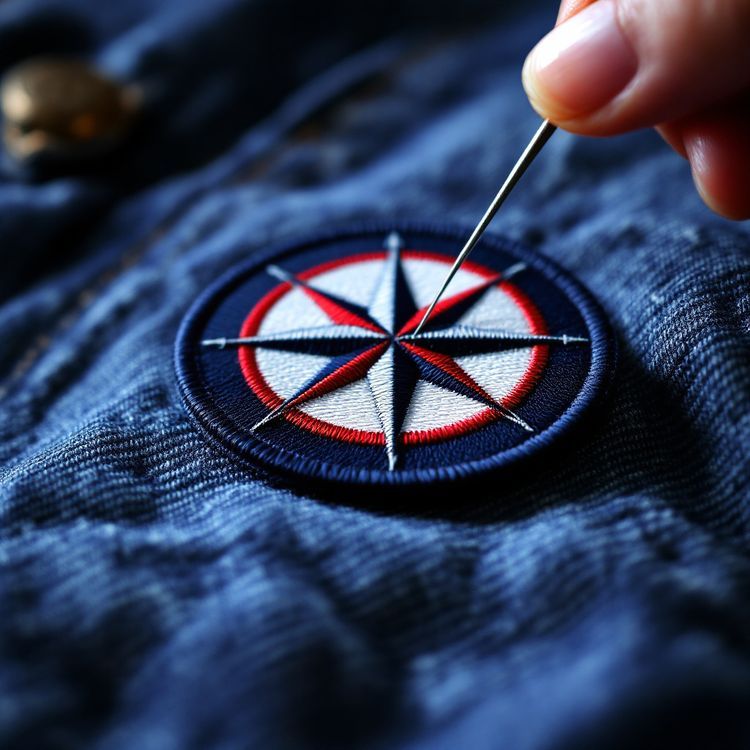
- Stitch around the border with strong polyester thread, about 1/8 in (3 mm) apart, coming up through the denim and over the patch edge.
- Tie off inside the leg.
Sewing by machine
Most home machines cannot reach the middle of a narrow leg. For the knee or thigh, unpick about 8 to 10 in (203 to 254 mm) of the inseam, which on most jeans is a simple seam, open the leg flat, sew the patch on, and re-sew the inseam. The outseam is usually flat-felled or topstitched and harder to rebuild. Use a denim needle and a zigzag or straight stitch just inside the patch edge.
Ironing
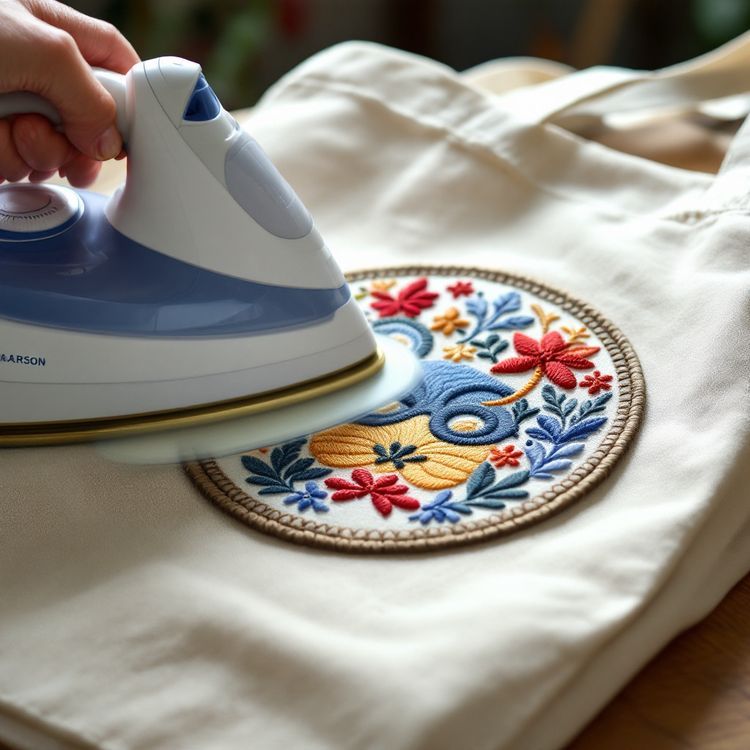
Iron-on patches bond well to cotton denim. Put a pressing board inside the leg, iron on the cotton setting with steam off, cover the patch with a cloth, and press firmly for about 30 seconds. Then turn the leg inside out and press the back. Our iron-on guide has the details. On jeans, follow up with a few stitches at the corners, or a full edge stitch on a knee.
Choosing patches that suit jeans
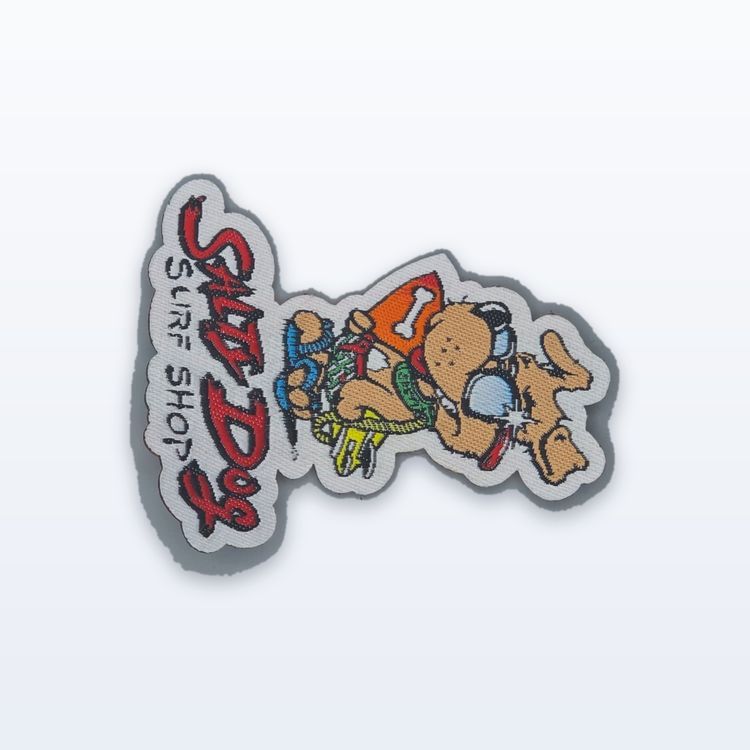
Embroidered patches have the classic look on denim and stand up to rubbing. Woven patches are thinner and more flexible, so they bend better at the knee and keep small detail clear. Sublimated patches work for photos and full-colour art on a thigh. Chenille is usually too thick and stiff for a pant leg.
Shape matters too. Circles, ovals and rounded rectangles sit flatter on a curved leg than shapes with sharp points, and a merrowed border gives you a firm edge to stitch over. If you want a die cut outline, keep the points blunt so they do not catch on pockets and bags.
For a matching set across a jacket and jeans, see our guide to denim jacket patches. If you are making patches for a brand, a band or a shop, our custom patches come in all six constructions with sew-on or iron-on backing. Send your artwork for a quote with the size and quantity, and we reply within about 2 to 3 business days.