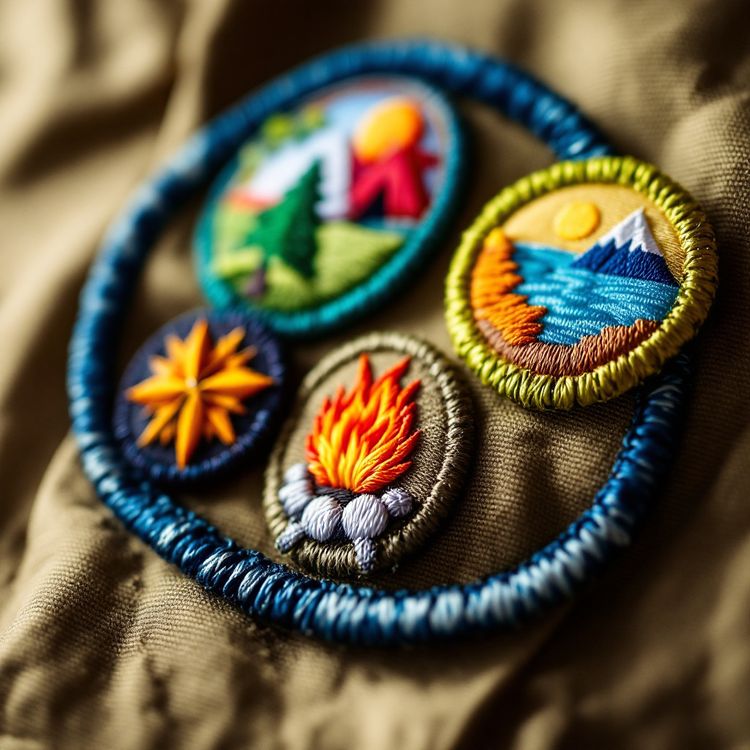
Custom scout and troop patches are usually 3 in rounds or simple shields, embroidered with a merrowed border, and ordered with enough spares for new members and trading. The things that decide whether the order goes well are the size and amount of text, the backing for kids' uniforms, the quantity, and above all the date the patches have to be in hand before the event.
This guide is for scout leaders, club officers and event organisers planning troop, pack, council, camporee or fundraiser patches. It walks through each decision in the order you will meet it.
Types of scout and club patches
Most groups order from a handful of familiar categories:
- Unit patches for a troop, pack, crew or club, worn as a permanent identity piece.
- Council and district patches for a wider organisation, often ordered in larger runs.
- Event patches for camporees, jamborees, summer camp, service projects, races and anniversaries. These usually carry a name, a place and a year.
- Merit style rounds for achievements, attendance or skills your group recognises internally.
- Fundraiser patches sold to members, families and supporters to raise money for trips or equipment.
Each type has a different life. A unit patch may be reordered for years, so it is worth getting the design right. An event patch is made once and has a fixed deadline. Our scout and club patches page shows the kind of work involved.
Size and construction
A 3 in round is the most common size for troop and event patches, large enough to read a name and a year without dominating a uniform sleeve or pocket. Larger council or anniversary designs often go to 3.5 or 4 in. In the trade, size is usually quoted as width plus height divided by two, so a 4 x 2 in rocker counts as a 3 in patch.
Embroidered or woven
Embroidery is the classic look: raised thread, bold colours and a texture kids recognise as a real patch. It works best with simple artwork and short text. As a general guide, embroidered lettering needs about 1/4 in (6 mm) cap height to stay readable, and lines thinner than about 1 mm do not stitch cleanly.
Event patches often carry a lot of text: an event name, a location, dates and a unit number. If that text has to fit around the rim of a 3 in round, a woven patch may read better, because woven thread holds smaller lettering and finer lines than embroidery.
| Design | Usually best as | Why |
|---|---|---|
| Bold emblem, unit number, short name | Embroidered | Raised texture, strong colour, classic look |
| Event name, dates and location around the rim | Woven | Holds small text that embroidery would blur |
| Detailed landscape or mascot | Woven, or embroidered at a larger size | Fine detail needs finer thread or more room |
| Photo or gradient sky | Sublimated | Printed in full colour, which thread cannot reproduce |
Borders and shapes
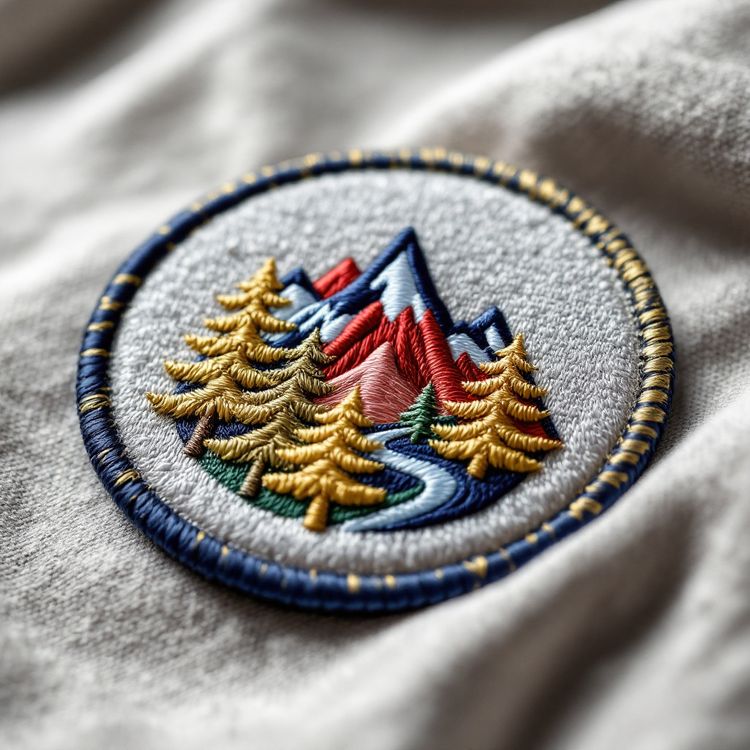
Rounds, ovals and shields almost always take a merrowed border, the raised wrapped stitch around the edge. It gives the finished rim people expect on a troop patch and holds up well to rough handling.
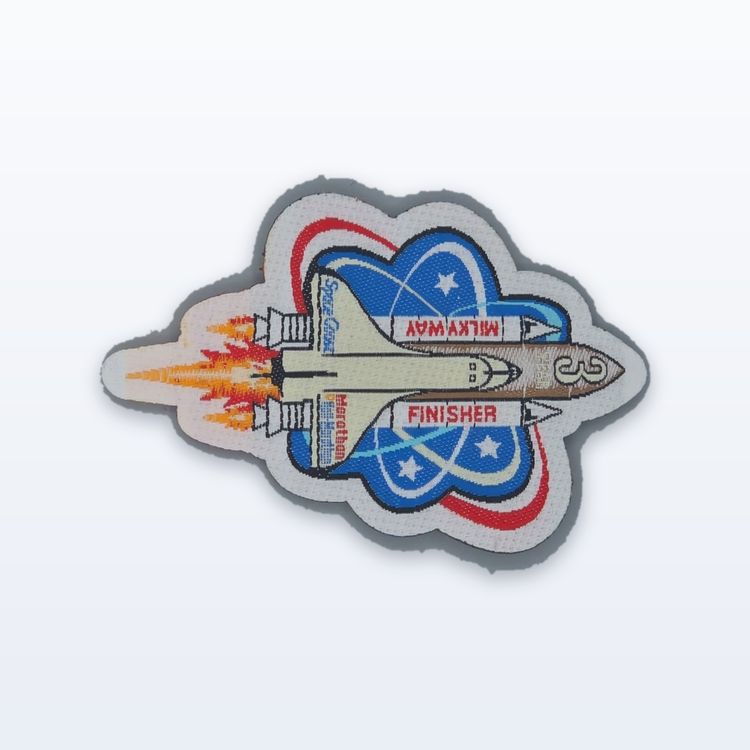
Custom shapes, such as a canoe, a tent, a state outline or a rocket, usually need a heat cut edge that follows the outline. Tight inside corners and fine points are hard to merrow. Our guide to merrowed vs heat cut borders explains where each one works.
Backings for kids' uniforms
Leaders and parents usually want patches that go on fast. Iron-on backing does that on cotton and cotton blend shirts. Adhesive alone can lift at the edges after many washes, so the reliable approach is to press the patch on, then add a few hand stitches around the border.
Sew-on is the most permanent choice and suits sashes, vests and blankets where patches stay for years. Hook-and-loop rarely suits uniforms but works for backpacks and gear. For a full comparison, see our guide to patch backing types.
Quantities, trading and fundraising
Count members first, then add for the extras that always appear: new members during the year, leaders and volunteers, replacements for lost patches, and a few for the unit's own records. If patch trading is part of your events, add a trading allowance on top. Trading is often the reason a troop runs out first.
Custom minimums start from 100 pieces for most products, confirmed on the quote. Larger runs generally lower the per-piece cost because setup is spread over more pieces, so ask for pricing at two or three quantities on one quote, for example 100, 200 and 500.
Fundraiser patches follow the same logic. Estimate realistic sales from families and supporters rather than a hopeful number. A unit patch design that is reordered later keeps its digitizing on file, so the reorder skips the setup.
Design for kids and collectors
Kids recognise shapes and colours before they read text. A bold central image, a clear unit number and two or three strong colours make a patch memorable. Collectors also value the year, so put it on event patches where it will read clearly.
Follow your organisation's own insignia and uniform rules on where unit and event patches may be worn. Do not include official emblems or trademarks without permission; check with your council or club office first.
Working back from the event date
Event patches have a hard deadline. Work backwards from the day you hand them out:
- Quote: one quote back in 2 to 3 business days after we receive your details
- Proof: usually 1 to 3 business days after artwork, approved in writing
- Allow time for one or two rounds of proof changes
- Production: typically about 3 to 4 weeks after proof approval, confirmed on the quote
- Shipping by UPS from Holly Hill, Florida, plus time to sort and bag patches
- A buffer of a week or more before the event
That usually means starting six to eight weeks out. A rush of around 10 business days is sometimes possible when the factory can hold it, but it cannot be promised, so do not plan around it.
Ordering your group's patches
Gather your artwork (a vector file is cleanest, a PNG or a clear sketch is enough to start), the size, colours, border, backing, quantity and the in-hands date. If you want to show the committee a draft first, upload the design to the free Patch Studio and download a mockup to share. When the details are ready, request a quote and we will send one price back, built on the factory price, with a proof to approve before anything is made. Our step by step guide on how to order custom patches covers each stage in more detail.