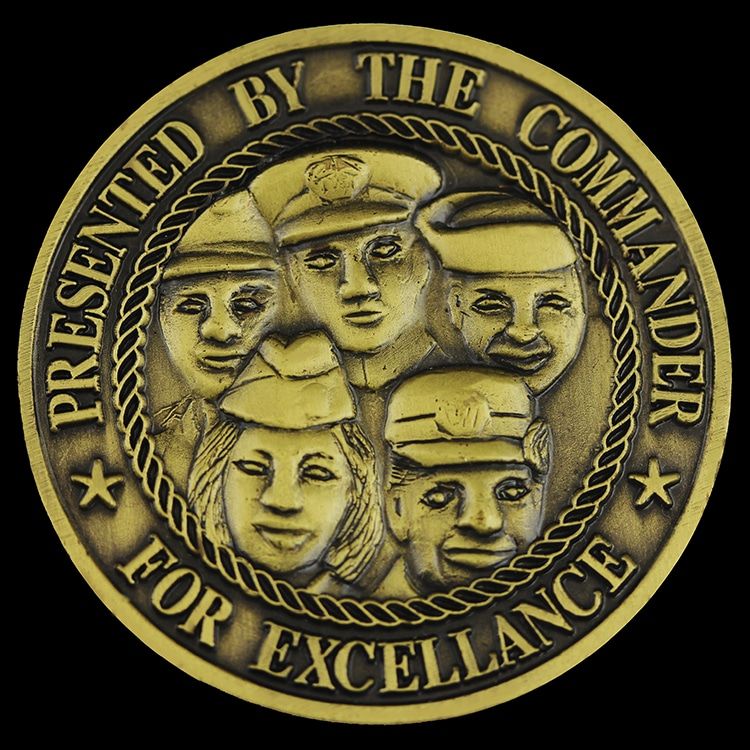
The best challenge coin display depends on how many coins you have and whether you want to pick them up. A few coins sit well in a desk rack or on stands, a growing collection fits a wall case with grooved shelves, and coins tied to a career or a person suit a shadow box. Put any coin you care about in a clear capsule first: it protects the plating and enamel from fingerprints and scratches and lets you show both faces.
This guide covers the main display options, how to arrange a collection so it tells a story, how to protect the finish, and how organizations can plan a coin with display in mind from the start.
Challenge coin display options compared
Most displays fall into one of five types. They can be combined, for example capsules inside a wall case, or a single stand on a desk next to a rack.
| Display | Holds | Best for | Watch out for |
|---|---|---|---|
| Single coin stand | One coin, upright | A special coin on a desk or shelf | Only one face shows at a time |
| Desk rack | A row or tiers of coins in grooves | Small collections you handle often | Dust and fingerprints on open coins |
| Wall case | Dozens of coins on grooved shelves behind glass or acrylic | Growing collections, offices and stations | Groove width must suit your thickest coin |
| Shadow box | Coins with patches, photos, insignia or a flag | Retirement, memorial and career displays | Plan the layout before you fix anything in place |
| Capsules or coin books | One coin each, sealed | Protecting valuable coins, storage, travel | Capsules are sized by diameter, so measure first |
Desk racks and stands
A rack keeps coins upright in a slot so the front face shows. It suits a handful of coins you want close at hand, such as the ones you carry for coin checks or the most recent ones you have received. Tiered racks fit more coins in a small footprint.
Wall cases
Wall cases are the usual choice once a collection outgrows a desk. Most have shelves with a groove that holds each coin upright, and a glass or acrylic door to keep dust off. Before buying, check the groove width against your thickest coin and the shelf spacing against your largest coin, because presentation coins can be far bigger than everyday ones.
Shadow boxes
A shadow box combines coins with other items: patches, rank insignia, photos, a folded flag or a name plate. It is the traditional way to mark a retirement or a career, and a thoughtful gift from a team. Many shadow boxes are made to hold a folded flag with space for coins and patches around it.
Protecting the finish
Coins are durable, but plating and enamel can wear, tarnish or scratch with handling. A few habits keep them looking new:
- Hold coins by the edge. Skin oils leave fingerprints that can tarnish plating over time.
- Use clear capsules for coins you care most about. Measure the diameter and thickness first, since capsules are made to fit specific sizes.
- Choose holders made for coin storage. Collectors generally avoid soft PVC flips for long term storage, because the plastic can leave residue on metal.
- Keep displays out of strong direct sunlight and away from damp areas such as bathrooms and garages.
- Do not polish an antique finish. The darkened recesses are part of the design, and metal polish strips them out.
- Dust with a soft, dry cloth or a soft brush. Avoid household cleaners on enamel and plating.
How to arrange a collection
A display reads best when it has an order. Pick one that fits the story your coins tell:
- By time: coins in the order you received them, so the case reads like a career or a membership history.
- By organization: units, departments or clubs grouped together, often with the most senior coin at the top.
- By occasion: deployments, promotions, anniversaries and events in separate rows.
- By person: coins received from particular leaders or colleagues, which is common in personal collections.
Leave space for coins still to come. A case that is full on day one has nowhere to grow. A small label under each coin, with the date and who presented it, turns a collection into a record that family and colleagues can read years later.

Showing both faces
The back of a coin often carries the most meaningful part: a date, a motto, a mission or a name. Many displays hide it. A few ways around that:
- Use capsules in a rack you can lift coins out of, so anyone can turn a coin over.
- Display two of the same coin, one face up and one face down, if you have both.
- Use a stand that holds the coin at an angle in front of a small mirror.
- Photograph the back and include it on the label or in the shadow box.
For organizations: a coin wall and a coin made for display
Stations, offices, clubhouses and headquarters often keep a display of every coin the organization has issued, or coins exchanged with other units and agencies. A wall case in a public area becomes a record of the organization's history and a point of pride for members.
If you are creating a coin, think about where it will end up. A few decisions make it display well:
- Choose a standard diameter, so capsules and cases fit. Our challenge coin size guide lists the common ones.
- Put the date and occasion on the back, so the coin explains itself in a case.
- Pick a finish that reads at a distance. An antique finish brings out relief behind glass, and our guide to coin edges, plating and finishes compares the choices.
- Ask about presentation packaging on your quote if the coin is handed over in a box or case.
- Consider serial numbers for limited issues, so each coin can be recorded.
Ordering coins for your organization
We make die struck and die cast coins to your artwork, with the size, plating, enamel and edge set at the proof stage. See the custom challenge coins page for both constructions, and our challenge coin design guide for planning both faces. When you are ready, request a quote with your artwork, size, quantity and in-hands date. Custom coins start from 100 pieces, quoted from the factory price, and nothing is made until you approve the proof in writing.