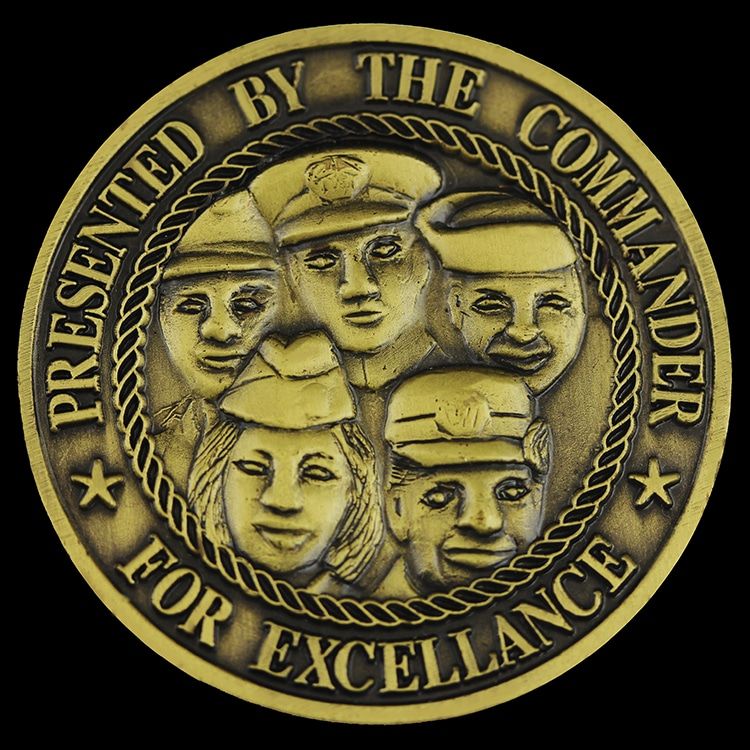
The core challenge coin rule is simple: if a member of your group shows their coin and challenges you, you have to produce your own coin right away. If you cannot, you buy the round. If everyone challenged can show a coin, the challenger buys instead. Beyond that, the exact rules vary from unit to unit and club to club, so the group that issued the coin always has the final word.
This post explains the coin check as it is most commonly played, how coins are presented and received, the etiquette that goes with carrying one, and what is known (and not known) about where the tradition started. If you are creating a coin for your own group, it ends with how to write your rules down so everyone plays the same game.
How a coin check works
A coin check, sometimes called a challenge, is the game that gives the coin its name. In its most common form it runs like this:
- The challenge. A member draws their coin and raises it, sets it down firmly on the table or bar, or taps it, so everyone present knows a check is on.
- The response. Everyone who carries the group's coin must produce it within a short time, often described as immediately, or within one step or arm's reach.
- The result. Anyone who cannot produce a coin buys a round, usually a drink, for the challenger and the others who answered. If every person challenged produces a coin, the challenger buys the round for the group.
That last rule is what keeps the game honest. Challenging too often, or challenging people you know are carrying, gets expensive. A well timed check, on the other hand, is part of the fun and a reminder to keep your coin on you.
Common rules, and where groups differ
Because there is no single governing body, rules drift. These are the points where groups most often add their own detail:
| Rule point | Common version | Where it varies |
|---|---|---|
| Which coin counts | The coin issued by the group | Some groups accept any coin from the same organization, others only their own |
| How close it must be | On your person or within arm's reach | Some allow one or two steps, others require it in hand within seconds |
| Coins on keyrings or belts | Often do not count in traditional rules | Some groups accept any carried coin |
| Dropping a coin | Counts as a challenge to everyone present | Some groups ignore accidental drops |
| Handing your coin over | Giving it to someone to inspect can mean they keep it | Many groups treat this as a joke rather than a rule |
| Number of rounds | One round per person who fails | Some cap it, some only count the first to fail |
| Where checks are allowed | Social settings only | Some groups ban checks at ceremonies, funerals or work |
The keyring point matters if you are ordering coins. A coin with a keyring attachment is convenient for everyday carry, but in groups that follow the traditional rules it may not count in a check. If your coins are meant for the game, ask your members which they would rather carry before you add an attachment.
How a coin is presented
Challenge coins are often handed over as a personal recognition from a leader: for a job well done, at a promotion, on a deployment, at retirement, or to mark membership in a unit or club. The best known way to present one is the handshake.
- The presenter holds the coin in the palm of their right hand.
- They shake hands with the recipient, passing the coin from palm to palm during the handshake.
- A few words go with it: what the recognition is for, said plainly and specifically.
The handshake keeps the moment personal and low key. It is common in military, law enforcement and fire service settings, and it carries across well to civilian groups and companies. For a formal ceremony, the coin may instead be presented openly, in a case or on a stand, with the reason read out to the room.

Challenge coin etiquette
Most of the etiquette comes down to respecting what the coin stands for.
- Carry your coin if your group plays the game. Leaving it at home is how you end up buying the round.
- Treat a coin you were given as earned recognition. It is generally poor form to present a coin you bought as one you were awarded.
- Do not challenge people outside the group who never received the coin, unless the group plays that way.
- Keep checks for social settings. Interrupting a ceremony or a serious moment with a coin check is widely seen as bad manners.
- Accept a presented coin with thanks and a firm handshake, and do not inspect it like a purchase in front of the person giving it.
- Keep collected coins somewhere safe and visible. Our guide to displaying challenge coins covers racks, cases and care.
Where the tradition comes from
Nobody can point to the first challenge coin with certainty, and much of the history is told as story rather than record. The most repeated version is set in the First World War: an American pilot, carrying a bronze medallion issued to his squadron, is shot down and captured, escapes, and proves his identity to French troops with the medallion. Historians treat that story as a legend rather than a documented event, but it is the one most people learn first.
What is better established is that unit coins and medallions became common in the US military in the second half of the 20th century, and the coin check grew up alongside them as a social game. From there the custom spread to police and fire departments, veterans' groups, government agencies, clubs and companies. Today coins are as likely to mark a department anniversary or a corporate milestone as a military unit.
Because so much of the history is oral, be careful when you write it on a coin card or in a ceremony speech. Saying "the tradition is often traced to" is more accurate than presenting one story as fact.
Making a coin for your group? Write the rules down
If you are creating a coin, deciding the rules up front saves arguments later. A short rules card, given out with the coin, is a common way to do it. Cover these points:
- Who receives the coin and for what.
- Which coins count in a check, and whether keyring coins are allowed.
- How close the coin must be, and how long people have to produce it.
- What the stakes are, with a clear no pressure to drink rule.
- Where and when checks are off limits.
- What happens if a coin is lost, and how a replacement is issued.
The coin itself should be built for how it will be used. A coin carried daily for checks wants a practical size, a durable finish and a design that reads at a glance. Our challenge coin size guide and the challenge coin design guide cover those choices. When you are ready, see the options on our custom challenge coins page and send the details for a quote. Every coin is priced from the factory price and nothing is made until you approve the proof in writing.