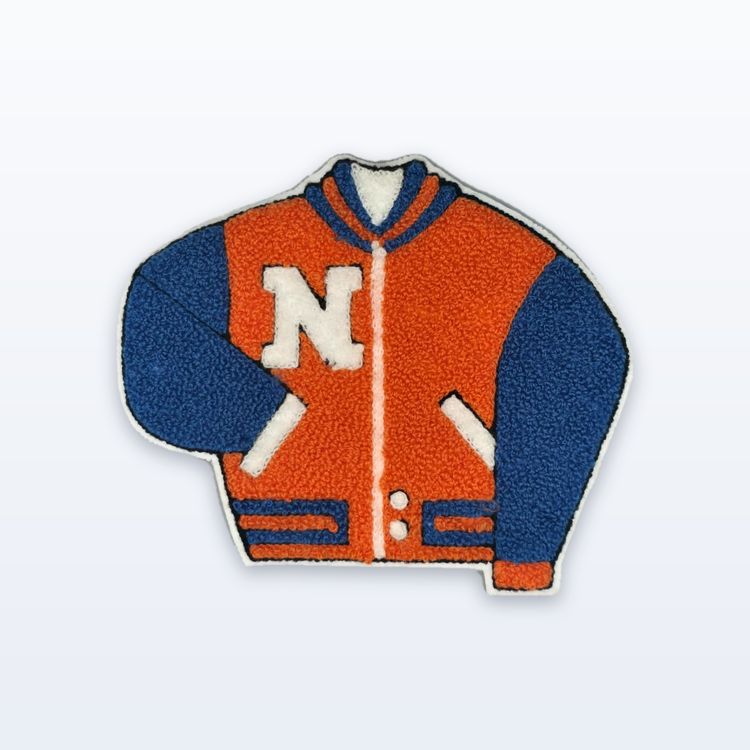
Chenille patches for letterman jackets are made from looped yarn tufted onto a felt base, which gives the thick, soft, raised texture people recognise from varsity letters. They suit bold shapes: a single letter, a simple mascot or a year numeral, usually in two or three school colours. If your design has fine detail or small text, chenille is often combined with embroidery for those parts.
Below we explain how chenille is built, which sizes and designs work, how to attach it, and how to order for a whole athletic or activities program.
What chenille is and how it is built
A chenille patch starts with a felt base cut to shape. Yarn is then stitched into the felt in tight loops, building a raised pile that you can feel standing up from the surface. The loops are what give chenille its fuzzy, towel-like look.
Most letters and mascots use more than one layer of felt. A common build is a chenille centre on one colour of felt, set on a second, larger felt in a contrasting colour, so a narrow outline frames the letter. Some designs add a third layer for a wider, bolder border. Each layer is cut slightly larger than the one above it.
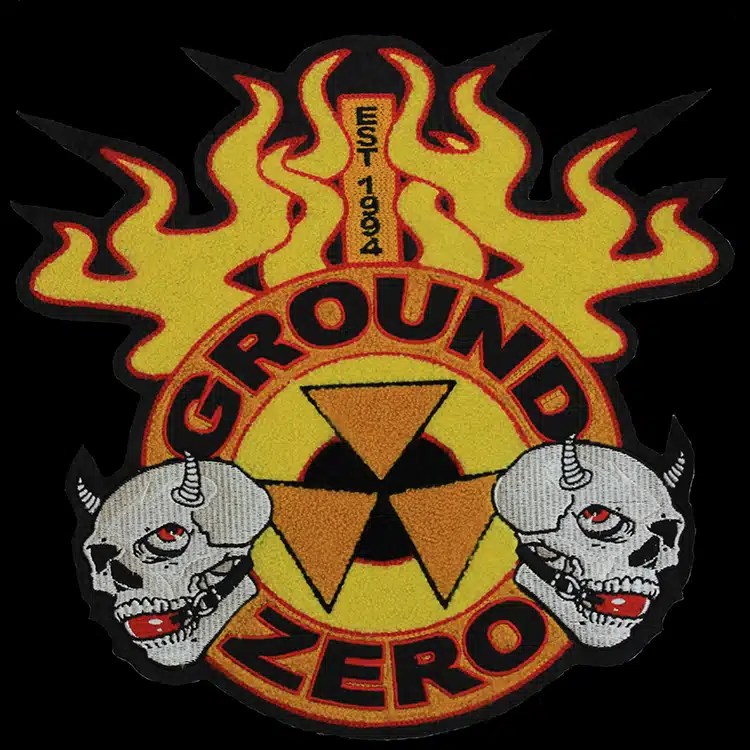
Fine lines and lettering usually go in as embroidery, either a flat satin stitch or a chain stitch, which sits alongside the chenille areas. That combination lets a mascot have a chenille body with embroidered eyes, outlines or a name.
Letters, mascots and year numerals
Varsity letters
The school letter is the centrepiece of most letterman jackets. It is usually a block or old English style initial, worn on the left chest. Keep the letter shape clean and avoid thin serifs, because the pile softens edges and very thin strokes do not tuft well.
Mascots
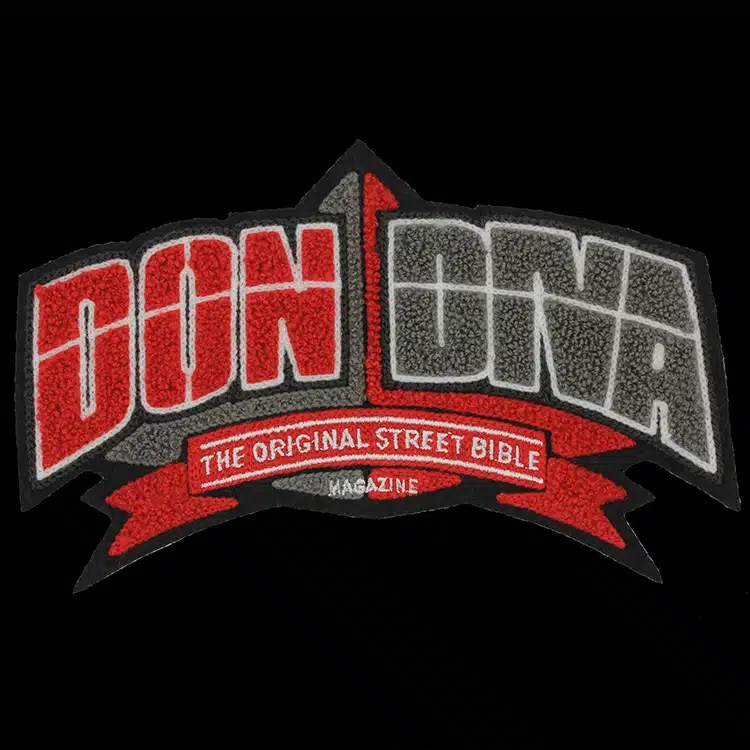
Mascots go on the sleeve, the chest or the back. Simplify them before you order. Large areas of solid colour translate well into chenille; small details like teeth, feathers or claws are better outlined in embroidery or dropped altogether.
Shape matters too. A mascot cut to a simple outline, or set inside a shield or circle, is easier to produce and easier to sew on than one with many thin points. If the mascot needs a name, put it in a band or banner of its own rather than squeezing it between the tufted areas.
Year numerals and activity patches
Graduation year numerals are often worn on a sleeve. Many programs also award small activity patches or insignia for each sport, club or achievement, worn on or near the letter. These are usually small, so they work best as simple shapes or as embroidered patches rather than full chenille.
Sizes and school colours
There is no fixed standard, but as a general range a chest letter is commonly somewhere between 5 and 8 in tall. Year numerals and sleeve patches are smaller, and a back mascot can be much larger. Measure the jackets your students actually wear, since youth and adult sizes vary.
Chenille holds bold shapes, not fine detail. As a rule, the smaller the patch, the simpler the design must be. If you need a name, a slogan or a detailed crest at a small size, make that part embroidered.
School colours are matched across three materials: the chenille yarn, the felt and any embroidery thread. Send your official colour references with the quote request, and check them on the proof. Navy, maroon, forest green and gold are common school colours, and close shades can look different from one material to another, so it helps to have a physical sample to compare.
Chenille vs embroidered vs tackle twill
Chenille is not the only option for school and team apparel. Satin tackle twill, where cut twill fabric is stitched onto the garment with a sewn edge, is common for names and numbers. Embroidered patches suit smaller emblems and detailed crests. Our comparison of embroidered and woven patches covers the flat-thread options in more depth.
| Chenille | Embroidered | Satin tackle twill | |
|---|---|---|---|
| Texture | Thick, soft, raised pile | Raised, firm thread | Smooth fabric with stitched edge |
| Best for | Varsity letters, bold mascots, numerals | Crests, small logos, fine text | Names, numbers, large shapes |
| Detail | Low; simple shapes only | Medium; text down to about 1/4 in | Low to medium; often paired with embroidery |
| Typical size | Large | Small to medium | Medium to large |
| Usual attachment | Sewn | Sewn, iron-on or hook-and-loop | Sewn |
Attaching chenille to a letterman jacket
Chenille patches are normally sewn on. Letterman jackets usually have wool bodies, and wool and thick felt do not hold heat adhesive well. The felt base also takes a stitch cleanly around its outer edge, so sewing is both the strongest and the neatest finish.
A local tailor, alteration shop or embroidery shop can sew letters and patches onto jackets, often in one visit. If you want to do it yourself, pin the patch in place, check the position on the wearer, and stitch through the outer felt layer just inside the edge with matching thread.
Be careful with the jacket's leather sleeves. Stitching through leather leaves permanent holes, so decide on sleeve patch placement once.
- Check placement with the jacket on, not lying flat.
- Use thread that matches the outer felt colour.
- Stitch through the felt border, not the chenille pile.
- Avoid iron-on and heat on wool and leather.
- Dry clean or spot clean, following the jacket maker's care label.
Ordering for a whole program
Most coaches and athletic directors order letters once or twice a year, ahead of awards nights and banquets. Custom runs start from 100 pieces for most products, confirmed on the quote, so it often makes sense to order enough letters for several seasons at once and add year numerals and activity patches alongside.
A larger run generally lowers the cost per piece because the setup is spread across more patches. Ask for pricing at two or three quantities, such as 100, 200 and 500, on the same quote. Our guide to what drives custom patch cost explains the other factors, including size, felt layers and colour count.
Booster clubs often sell patches or jackets as a fundraiser, and schools order patches for clubs, bands and academic teams as well as sports. See our patches for schools for more ideas.
Requesting a quote for chenille
To see a design before you send it, upload your letter or mascot to the free Patch Studio, choose chenille, set the size, and preview it on a jacket. It is a rendering, and we review detail and size when we quote.
Then send your artwork, sizes, school colours, felt layers, quantities and awards date through our quote form. We price it with 2 or 3 factories and send one quote within 2 to 3 business days. Your proof is approved in writing before production, which typically takes about 3 to 4 weeks after approval.