Motorcycle club patches are usually planned as a set: a large centre back patch, a curved top rocker with the club name, often a bottom rocker, plus smaller chest patches and name or officer tabs. The centre is commonly 8 to 12 in, the rockers are sized to match its width, and everything is embroidered, sewn on and ordered together so the colours and lettering match.
This guide is for club officers and riding groups designing a new set or remaking an old one. It covers layout conventions, sizing, construction, borders, backing for leather and denim, and how to order so every member's vest matches.
Back patch layouts: one, two and three piece
Riding groups use three general layouts. The names describe how many separate pieces make up the back.
| Layout | Pieces | Commonly used by |
|---|---|---|
| One piece | A single patch with name and emblem together | Riding groups, owners' groups, charity rides, social clubs |
| Two piece | Top rocker with the name, plus a centre emblem | Riding clubs and associations |
| Three piece | Top rocker, centre emblem, bottom rocker | Traditionally associated with established clubs |
These are general conventions, not rules we set. In many riding communities a three piece back and a bottom rocker carry specific meaning, and a bottom rocker that names a city, state or region can be read as a territorial claim.
We make patches to the design you send. Respecting club etiquette and local norms is your call, and it is worth settling before the artwork is final.
Sizing the centre, rockers and chest patches
Measure the vest or jacket back first. The centre patch has to sit inside the panel with room around it for the rockers, and a large rider's vest and a small one can differ by several inches.
- Centre back patch: commonly 8 to 12 in. Larger reads from further away; smaller suits a short or narrow back panel.
- Rockers: sized so the width matches or slightly exceeds the centre. Height is usually set by the lettering, often 2 to 3 in for a back rocker.
- Chest patches: often 3 to 4 in, worn on the front panels.
- Name and officer tabs: small rectangles, commonly 3.5 to 4 in wide, with one name or title each.
Cut a paper template at your planned sizes and pin it to a member's vest. It is the fastest way to see whether the set fits before anything is made. Our patch size guide covers measuring in more detail.
Matching the rocker curve to the centre
A top rocker arches over the centre patch and a bottom rocker curves under it. The curve should follow the outline of the centre so the gap between pieces looks even all the way across. Send the centre artwork and the rockers together so the curves are drawn as one set, not as three separate jobs.

Embroidered, woven or chenille
Embroidered is the standard for club backs. Raised thread reads from a distance, holds up to weather and road grit, and has the traditional look riders expect. Higher stitch coverage gives a solid, heavy patch.
Woven suits detailed emblems with fine lines or small lettering, such as a chapter name inside a centre design. It is thin and flat, which some riders like on a denim vest and others find too light for a back piece.
Chenille gives a tufted, raised pile with a vintage feel. It suits bold, simple shapes and large letters, and works best on jackets rather than as a fine detailed back patch.
As a general guide, embroidered lettering needs about 1/4 in (6 mm) cap height to stay readable. Rocker lettering is far larger than that, but small text in the centre emblem is where embroidery can blur. See all constructions on our motorcycle club patches page.
Borders and thread colours
Rockers and simple centre shapes such as circles, ovals and shields usually take a merrowed border, the raised wrapped stitch around the edge. It frames each piece and resists fraying on a vest that sees wind and rain.
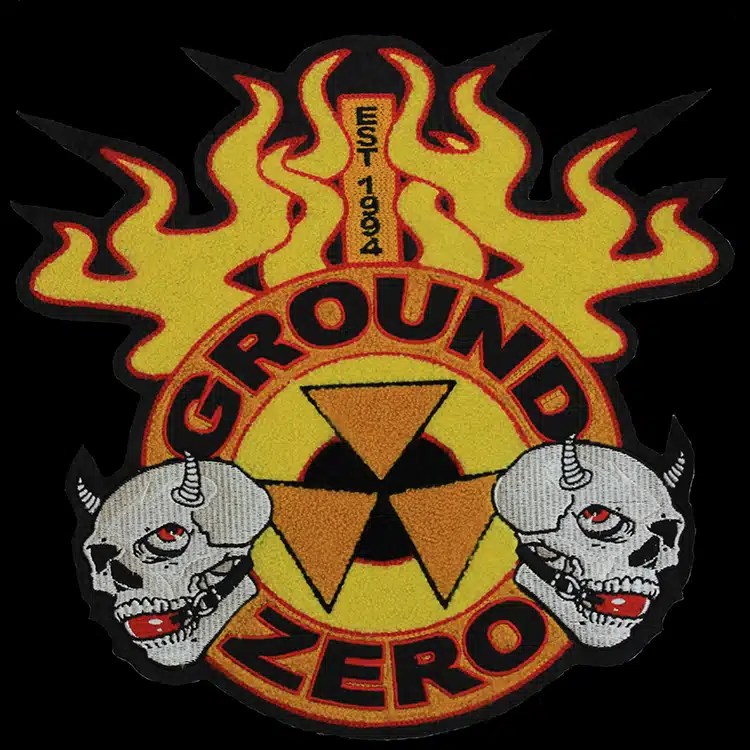
Centre patches with skulls, wings, flames or other detailed outlines often need a heat cut edge that follows the design, because merrowing cannot turn tight inside corners or fine points. Our guide to merrowed vs heat cut borders explains the trade-off.
Keep thread colours consistent across the set. If the rocker lettering and the centre outline share a colour, specify the same thread for both, and keep the border colour the same on every piece. Two or three strong colours on black or a dark twill read clearly at a distance.
Attaching to leather and denim
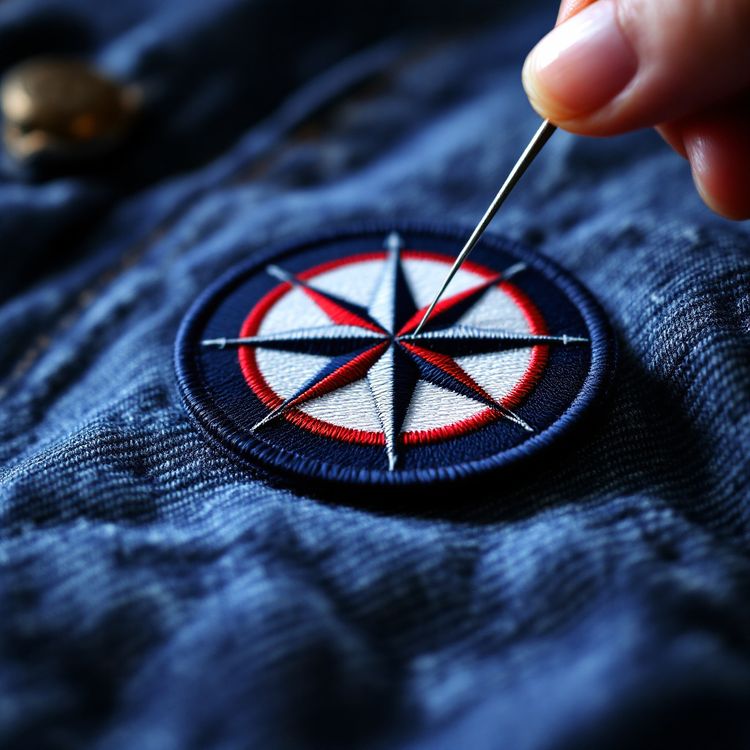
Club patches are sewn on. Iron-on adhesive does not bond to leather, heat can damage it, and adhesive alone will not hold a large back patch on denim through years of riding and washing. Order sew-on backing for the full set.
Leather vests are best handled by a leather or saddlery shop with a heavy needle and strong thread. Denim can be sewn by any tailor or at home with a heavy duty needle. Stitch just inside the border all the way round. For a full comparison of options, see our guide to patch backing types.
Ordering matching sets for members
Order the whole set at once: centres, rockers, chest patches and tabs. Pieces quoted, proofed and made together are checked against each other, which keeps colours and lettering consistent across every vest.
- Artwork for the centre and each rocker, sent together
- Vest or jacket back measurement, and the finished size of each piece
- Layout: one, two or three piece
- Construction and border for each piece
- Thread colours, with the same colour named for shared elements
- Sew-on backing for leather and denim
- Quantity of each piece, including spares for new members
- Names and titles for officer and name tabs
- Your in-hands date, such as a ride or anniversary
Plan for new members. Custom minimums start from 100 pieces for most products, confirmed on the quote, and larger runs generally lower the per-piece cost. Spares in a drawer mean a new member's vest matches the rest. When you do reorder, the digitizing stays on file, so the reorder skips the setup.
Getting your club set quoted
If you want to check proportions before you commit, upload the centre artwork to the free Patch Studio and preview it on a black jacket at your chosen size. When the details are ready, request a quote. We send the job to two or three factories, come back with one quote in 2 to 3 business days, and send a proof for written approval before anything is made.