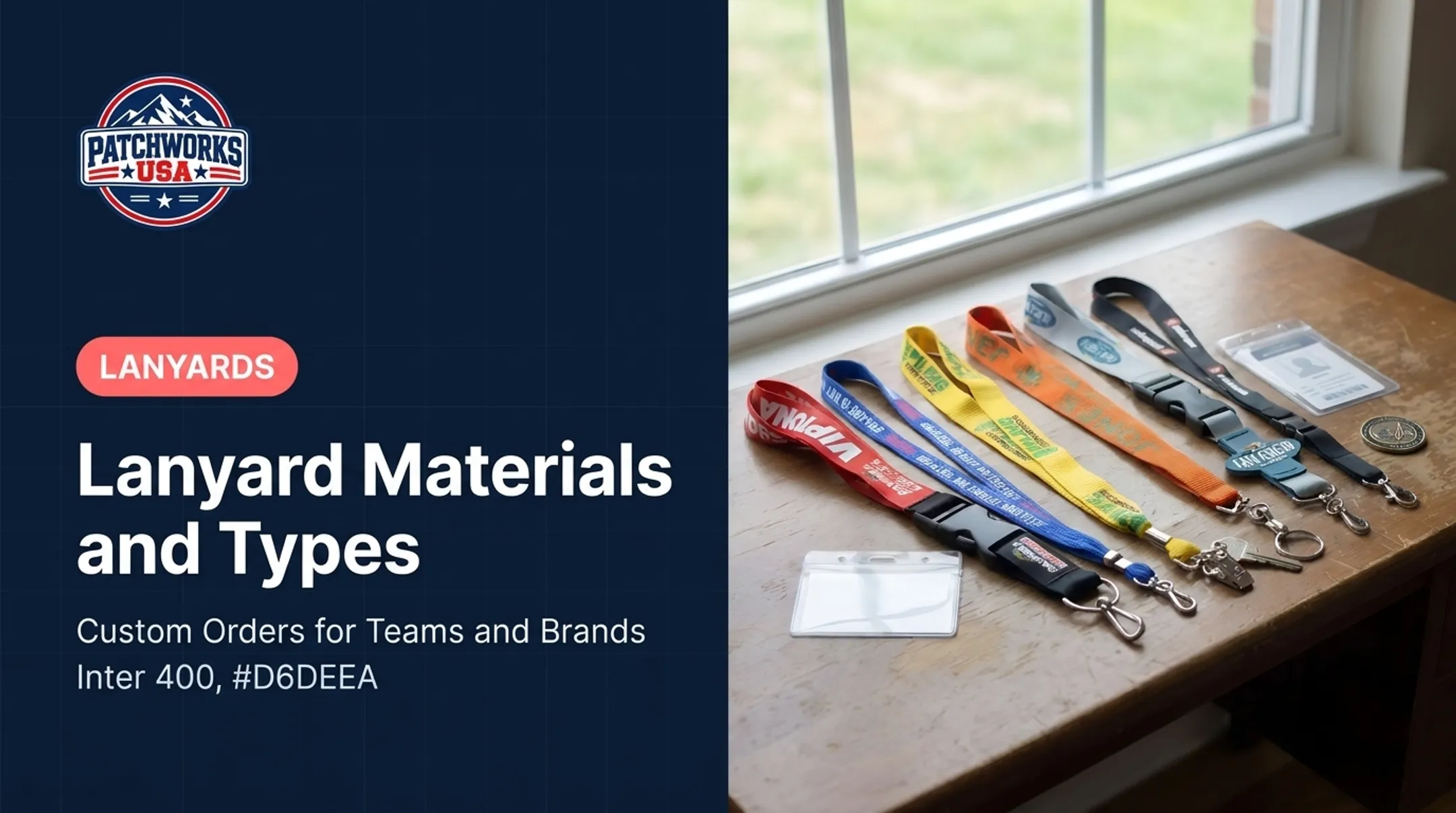

The choice changes how a lanyard looks, feels against the neck, takes a print, and holds up over months of wear. It also shapes your order cost and how soon you replace them.
The honest answer is that neither wins every time. Use case, artwork, wearing conditions, quantity, and budget decide it. This guide compares the two on cost, durability, appearance, and printing, then shows how to match each to a real order.
Key Takeaways
- Nylon often looks smoother and shinier, which suits a premium feel.
- Polyester suits event runs and full-color artwork, especially with dye sublimation.
- Finish does not identify fiber, so ask suppliers for the actual composition.
- Width, weave, printing method, and hardware matter as much as the fiber.
Nylon vs Polyester Lanyards: Quick Comparison
| Factor | Nylon | Polyester |
|---|---|---|
| Fiber | Polyamide family | Terephthalate ester family (PET is one example) |
| Typical look | Smooth, often shiny | Varies: matte to soft satin |
| Common decoration | Screen print, woven designs | Screen print, offset, dye sublimation, sewn-on designs |
| Cost | Varies by order | Varies by order |
Composition
Nylon is a polyamide. The BISFA terminology guide names polyamide 6 and polyamide 66 as the main types. Polyester is defined through terephthalate ester chemistry, with PET as the best-known example.
Fiber and finished lanyard are separate things. Flat, tubular, and woven styles are construction choices, not extra fiber families. Watch the labels, too: one manufacturer sells a shiny "imitation nylon" strap that is 100% polyester. Shine alone tells you nothing about fiber.
Cost and order economics
No reliable price gap between nylon and polyester holds across suppliers. Quantity, width, imprint colors, attachments, and deadline all move the quote. Some suppliers include the first imprint color and charge for more, while dye sublimation has no color-count limit.

Compare quotes for the same width, colors, and hardware. A material-only price comparison misleads.
Durability and environment
Fiber reference data gives some direction, though it isn't finished-lanyard testing:
- Strength: Coats' fiber guide calls nylon strength "exceptionally high" and polyester "good to excellent."
- Abrasion: Texas A&M groups both fibers in good-to-excellent.
- Moisture regain: nylon takes up 4.0-4.5%, polyester 0.4-0.8%, at 70°F and 65% humidity. That is fiber behavior, not waterproofness.
- Sunlight: sources disagree. Coats rates both "good," while Texas A&M rates polyester higher.
No test ranks finished lanyards by lifespan, so don't trust a universal "stronger" claim.
Appearance and texture
Nylon offerings are commonly described as smooth, slightly stiff, and glossy. Polyester ranges widely. One dye-sublimated satin polyester is marketed as smooth and soft against the neck, while flat screen-printed polyester usually looks flatter. Weave and finish change both.
Printing and customization
- Nylon: screen printing gives crisp imprints, and some suppliers offer woven-in designs.
- Polyester: screen print, offset, dye sublimation, and sewn-on designs are all available.
- Full-color photos and gradients: dye sublimation on polyester is the documented route.
What Is Nylon?
Nylon is a synthetic polyamide fiber. In lanyards it usually shows up as woven webbing with a smooth surface and a softer hand than many polyester straps.
That smoothness helps a program that wants a premium look, such as long-term staff ID. Patchworks USA nylon lanyards use a smooth woven strap with a softer hand than polyester, which supports sharp screen or dye printing.
Tradeoffs to weigh:
- Costs can run higher on some orders, depending on construction.
- A glossy surface can shift how printed colors appear.
- Sunlight ratings differ between textile references, so ask about outdoor use.
- Complex full-color artwork usually points to sublimation instead.
"Nylon lanyard" is not one product. Width, weave, thickness, and finish change the result, so confirm all four before you compare quotes.
Use Cases of Nylon Lanyards
Nylon can fit:
- Long-term employee ID
- Premium branded programs
- Departments that want a smooth, substantial strap
It may be less suitable when the lowest unit price is the goal, when artwork is dense and full-color, or when lanyards will sit in direct sun for long stretches. Match the attachment and breakaway option to the load.
What Is Polyester?
Polyester is a synthetic fiber made from terephthalate ester chemistry. Lanyard makers use it in several formats:
- Flat woven strap with screen-printed artwork
- Tubular round, hollow-core strap with a rope-like feel
- Woven jacquard artwork woven directly into the strap
- Full-color sublimated edge-to-edge artwork and gradients
For branding, polyester’s strength is decoration range. One supplier's screen-printed polyester runs 1-3 colors, while sublimated satin polyester handles photos and gradients with no color limit. That is why polyester dominates large promotional and event orders.
Tradeoffs: feel and surface depend heavily on construction, and a lower material cost does not guarantee a lower total cost. A faded or scratchy strap that gets replaced early erases the savings.
Design limits depend on the process. Spot-color printing excludes gradients and shadows. Woven designs work best at three colors or fewer, and complicated artwork may not suit weaving. Minimum readable QR code size varies by printer and scanner, so request a proof and test-scan it before you order.

Use Cases of Polyester Lanyards
Polyester suits conferences, trade shows, festivals, schools, promotions, and everyday staff badges. Patchworks USA offers polyester lanyards for everyday badges and event credentials.
Review it more carefully for heavy daily use, frequent snagging, heavy attached items, or unusual heat, moisture, or sun. Fiber melting points offer little guidance here because they are not lanyard operating temperatures.
Nylon vs Polyester: What Is Better?
Neither, universally. Decide on these criteria:
- How long the lanyards must last
- Indoor or outdoor use
- Artwork complexity
- Wearer comfort
- Attachments and weight
- Quantity and budget
Comfort and wearability
Nylon tends toward a smooth, slightly stiff feel. Satin polyester can be just as soft. Edge finishing, width, and twisting matter as much as the fiber.
For sensitive skin, a 2022 patch-test study found reactions to disperse dyes used on polyester and polyamide in textile-dye-positive patients. It studied garments, not lanyards, and ranks neither fiber as safer.
Outdoor and operational conditions
Polyester absorbs less moisture as a fiber. UV and fade performance depend more on weave, finish, and dye than on nylon versus polyester alone. For a multi-day outdoor event, ask the supplier for outdoor-use specs instead of leaning on fiber stereotypes.
Matching artwork to the process
- Simple, high-contrast logo: screen print on either material
- Multicolor, gradients, photos: dye-sublimated polyester
- Small text or fine lines: request a proof first
Short-term price vs total value
Look past unit price. Count minimums, setup charges, shipping, attachments, and replacement frequency. A cheaper lanyard that fades by midseason costs more.

Situational picks
- Choose nylon for a smooth, premium-feeling strap in a long-term program.
- Choose polyester for detailed branding, events, or tighter budgets.
Patchworks USA makes custom lanyards from your artwork. Each job is quoted individually from size, quantity, colors, hardware, and in-hands date. Proof approval comes before production, and quotes return within one business day.
Real-World Examples and Case Studies
Side-by-side buyer case studies comparing nylon and polyester are hard to find. Product specifications and gallery examples still show how each material is typically used:
- A flat polyester lanyard with screen print in 1-3 colors, offered for conferences, trade shows, and schools.
- A 3/4 x 32 inch polyester lanyard with two-sided dye sublimation and a snap buckle release, sold for name badges.
- A white polyester lanyard on an employee ID, branded with a company logo and phone number, from Patchworks USA's gallery.
The pattern is clear: polyester is typically specified when branding detail or event volume leads. Nylon appears where feel leads. These examples show common use cases, not measured performance outcomes.
Ready to see your design on a lanyard? Submit your artwork to Patchworks USA for a custom quote.
Conclusion
Nylon makes sense when you want a smooth look and a premium feel. Polyester fits detailed branding, event programs, and cost-conscious runs. Both depend on construction and print method.
Judge the whole product:
- Fiber and weave
- Width and decoration
- Attachment and breakaway feature
- Quantity and environment
Patchworks USA offers widths from 1/2 to 1 inch, several attachments, and neck or buckle safety releases, with custom lanyards starting around 100 pieces.
Frequently Asked Questions
Which is better for lanyards: nylon or polyester?
Nylon suits a smooth, premium feel. Polyester suits detailed branding, events, and budget control. The right pick depends on the full specification.
Are nylon or polyester lanyards unsafe or unhealthy?
Safety depends on dyes, finishes, hardware, skin sensitivity, and breakaway requirements. No material is universally hypoallergenic. Ask your supplier for safety documentation.
Are nylon lanyards stronger than polyester lanyards?
Fiber guides often rate nylon higher in raw strength, though finished lanyard strength still depends on construction. Weave, width, stitching, and hardware also decide breaking strength.
Which lanyard material is best for outdoor events?
Polyester absorbs less moisture, though UV performance varies by product. Compare event length, color retention, and print method, and ask for outdoor specs.
What printing method works best on nylon and polyester lanyards?
Screen printing works on both for simple logos. Dye sublimation on polyester suits full-color art. Always approve a proof before bulk production.