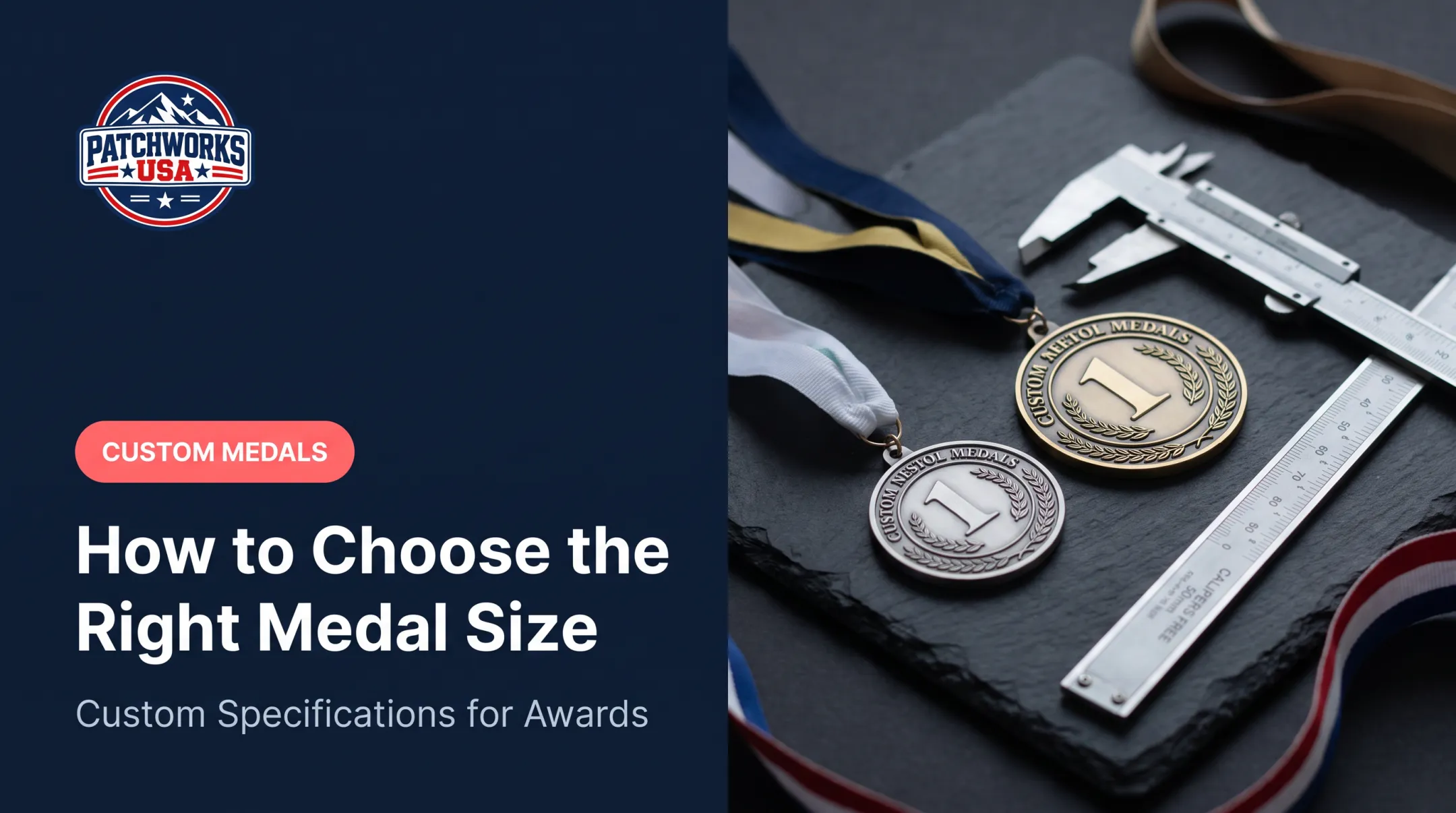

There is no single mandatory size for every challenge coin. The right specification depends on the coin's purpose, the artwork, and whether people will carry it or put it on a shelf.
This guide covers common diameters, thickness, design trade-offs, how to measure and validate size, and how to choose.
Key Takeaways
- "Standard size" means commonly ordered dimensions, not a universal rule.
- Smaller coins carry easily and suit simple art; larger coins give room for detail and display impact.
- Diameter and thickness are separate specifications, so judge them together.
- Check the final size against your artwork, use, budget, shape and proof.
What Challenge Coin Size Represents in Custom Coin Design
Size usually means diameter for round coins. For custom shapes, it means the maximum overall dimension. Thickness is a separate measurement of depth.
Surface area works as a design constraint. More area leaves room for text, logos, borders, enamel and dimensional relief. Less area forces simplification.
No Official Standard
Official military guidance does not set a mandatory universal diameter or thickness. Those sources cover recognition and customs, not dimensions. Some vendors do call certain sizes a standard. KidderCorp describes 1.75 in as an industry standard, but that is a vendor's characterization. Individual units or agencies may have their own procurement specs, so confirm with the group that is ordering.
Factors That Influence the Right Coin Size
Design Complexity
Fine lines, small lettering, multiple symbols and two-sided artwork all raise the minimum practical size. US Troop Gear publishes vendor guidance worth knowing:
| Feature | Vendor guideline |
|---|---|
| Line width | At least about 0.020 in (0.5 mm) |
| Small text | Below about 0.079 in (2 mm) sans-serif, or 0.098 in (2.5 mm) serif, risks blurring |
| Edge clearance | Keep text about 0.079 in (2 mm) from the edge |
These are one vendor's numbers, not universal tolerances. Prioritize legibility over cramming in every element.
Intended Use
KidderCorp's guidance maps size to purpose:
- 1.75 in (44.45 mm): pocket carry, handshake presentations, unit and deployment commemoratives
- 2 in (50.8 mm): commander recognition and intricate 3D artwork
- 2.25 to 3 in: desk display, retirement gifts, major awards
Shape and Cost
Long, thin outlines, shields, badges and cutouts can leave too little room for the remaining artwork. A shaped coin may need a larger overall dimension than a round one carrying the same art.
Cost moves with size, quantity, thickness, finish, colors, shape and deadline. Patchworks USA quotes every coin job individually, so a fixed price can't be promised without project details.
Decision rule: start with purpose and artwork, then choose the smallest size that keeps essential text and elements clear without making the coin awkward to carry.
Range of Challenge Coin Sizes
Published menus from three U.S. suppliers show how much the options overlap and differ. Available sizes vary by manufacturer, and these are menus, not hard limits on custom work.
| Diameter (in) | mm | Signature Coins | Challenge Coins Ltd | Aviator Gear |
|---|---|---|---|---|
| 1.5 | 38.1 | Yes | Yes | Yes |
| 1.75 | 44.45 | Yes | Yes | Yes |
| 2 | 50.8 | Yes | Yes | Yes |
| 2.5 | 63.5 | Yes | Yes | No |
| 3 | 76.2 | Yes | Yes | No |
| 3.5 | 88.9 | Yes | No | No |
| 4 | 101.6 | Yes | No | No |

For scale, a U.S. quarter is 0.955 in (24.26 mm) across and a half dollar is 1.205 in (30.61 mm). Even the smallest common coin is noticeably larger than either.
Smaller Sizes (about 1.5 in)
Small coins suit simple logos, short mottos, giveaways and daily carry. Expect limits with dense text, fine lines and complex relief.
Popular Mid-Range Sizes (1.75 to 2 in)
Signature Coins lists 1.5, 1.75 and 2 in as standard, calling 1.75 the average. Elite Custom Coins calls 1.5 in standard. Supplier defaults differ, so choose the size that fits your artwork and how the coin will be carried or displayed.
This range balances artwork space, hand feel, portability and cost. It fits unit, department, club, team, school, corporate and event coins with moderate detail.
Larger Sizes (2.25 in and up)
Larger diameters carry detailed scenes, long inscriptions, layered designs, 3D elements and special shapes. They suit retirements, anniversaries and display pieces.
The trade-offs are real: more weight, less pocket-friendliness and higher production cost. They fit presentation better than everyday carry.
How to Use the Range
| Purpose and design | Likely size category |
|---|---|
| Simple logo, giveaway, daily carry | Smaller |
| Moderate detail, may be carried | Mid-range |
| Intricate art, display, premium award | Larger |
These are recommendations, not rules. Before approving artwork, print a circle or sample at the intended final size and read it at arm's length.
Key Design Properties Beyond Diameter
Once diameter is set, thickness, weight, shape, relief and finish determine how the coin looks and feels.
Thickness
Thickness is depth, not width, and suppliers disagree on defaults:
| Supplier | Published thickness |
|---|---|
| Challenge Coins Ltd | Standard about 0.118 in (3 mm); upgrades to 4, 5 and 6 mm |
| Signature Coins support page | Usually about 0.157 in (4 mm); custom range 1.2 to 6 mm |
| Challenge Coin Company | About 0.118 to 0.138 in (3 to 3.5 mm) |

Patchworks USA coin configurations list about 0.098 in (2.5 mm), 0.118 in (3 mm) and 0.157 in (4 mm). Thicker coins feel heftier and allow deeper relief, but can cost more and carry less comfortably. Signature documented a custom Navy coin about 0.315 in (8 mm) thick at its thickest point, a custom example rather than a norm.
Weight and Portability
Weight depends on diameter, thickness, base metal and construction, not diameter alone. Brass is denser than zinc alloy, and cutouts reduce weight. A listed weight only matters when it matches a verified specification.
- Pocket coin: must be comfortable to carry daily
- Presentation coin: likely goes in a case, so heft matters more
- Display medallion: gets mounted, so weight matters least
Shape and Artwork Area
Custom outlines, shields and elongated designs can create narrow areas where text and fine detail don't reproduce well. Enlarge or simplify when needed, and confirm which dimension is used for quoting.
Detail, Relief and Finishing
Patchworks USA offers die struck coins, which give crisp lettering and fine lines, and die cast coins, which give deeper 3D relief, cutouts and multiple height levels. Edges can be smooth, rope, reeded or diamond-cut. Plating options include gold, silver, nickel or copper.
A bigger coin doesn't guarantee better detail. Line thickness, contrast, spacing and the manufacturing process still decide the result.
How Size Is Specified, Measured, and Validated
Specify size together with shape, thickness, base metal, finish, artwork, quantity and intended use so the quote matches what you plan to order.
Measuring Round and Irregular Coins
Round coins are measured across the diameter. Irregular coins are measured across their widest points, and the blank must be at least that large. Cutouts, extended points and separate elements all count toward the true maximum. Confirm the quoting convention with your manufacturer.
Artwork and Proof Validation
A digital proof and a manufactured pre-production sample are different stages. Check small lettering, narrow lines, border spacing and color separation on both sides. Before approving, confirm:

- Diameter and thickness
- Shape and edge treatment
- Intended use
- Quantity and deadline
- The final proof
Vector files (AI, EPS, PDF) give the cleanest results, though PNG files or a photo of an existing coin can start a quote at Patchworks USA.
What Happens When Size Is Misjudged
An undersized coin gets crowded artwork, unreadable text and weak hierarchy. An oversized coin gets bulky, costly and impractical to carry.
Common mistakes:
- Treating a popular size as mandatory
- Assuming a bigger diameter fixes poor artwork
- Comparing diameter without thickness and shape
Patchworks USA quotes each coin individually. Owner Brad Aboff personally reviews submitted artwork and helps steer the project toward a suitable production approach.
Conclusion
The best size balances artwork clarity, purpose, portability, thickness, shape, budget and the sense of occasion you want. No single standard decides it.
If you want help checking artwork and choosing a practical specification, request a custom quote from Patchworks USA before production begins.
Frequently Asked Questions
What is the standard size of a challenge coin?
There is no mandatory standard. Suppliers commonly list 1.5, 1.75 and 2 inches as frequent choices, and artwork and use should drive the final decision.
What is the standard thickness of a challenge coin?
Thickness is separate from diameter. Published defaults range from about 3 to 4 mm depending on supplier. Thicker coins feel heavier and allow deeper relief.
What are the rules for challenge coins?
"Rules" are customs, not sizing requirements. In one Air Force account, a challenged person has 60 seconds to produce a coin. Confirm specifics with the hosting organization.
Are challenge coins worth anything?
Value is mostly sentimental or commemorative. Some coins resell among collectors, but size alone doesn't determine monetary worth.
Is a challenge coin a big deal?
In military, public safety and team settings, often yes. The Air Force describes them as recognition of excellence. Meaning depends on the giver, context and recipient.
How much do 100 challenge coins cost?
It depends on size, thickness, finish, colors, shape, artwork, quantity and deadline. Published 100-piece tables run from about $3.51 to $7.00 each, with different scopes. Request an itemized quote.