
The usual problem is overcrowding. Groups try to fit every symbol, date, name and slogan onto one coin, and the result is unreadable. This guide pairs original design concepts with practical construction advice to avoid that.
The ideas apply to military and veteran groups, public-safety departments, schools, teams, clubs, businesses and event organizers across the United States.
Key Takeaways
- Pick one central story or symbol first, and give each face a different job.
- Memorial coins need restraint; team and event coins can carry more color and play.
- Choose shape, relief, plating and edging that reinforce the concept.
- Review proofs at actual size and confirm permission for protected artwork.
Unique Challenge Coin Design Ideas for 2026
Two-sided identity-and-story coin
Make one face the formal face of the organization: emblem, name or motto. Use the reverse for the story members recognize personally.
KidderCorp's 2026 guidance takes this approach, putting the official crest, designation and motto on the front and a deployment map or unofficial mascot on the back. Other pairings work too:
- A unit crest with a deployment milestone
- A company mark with its founding year
- A school emblem with a championship season
Custom silhouette or negative-space coin
Skip the default circle. A mascot, shield, aircraft, state outline, tool or landmark can define the coin's outline.
Keep the silhouette recognizable without tiny cutouts or fragile projections. Narrow bridges between voids are common bending points, and cutouts near the edge have less support. Confirm the die line with the manufacturer before you commit.
Map, route or topographic time capsule
A map outline, contour pattern, route or set of coordinates can commemorate a mission, expedition, tournament or shared destination. Pair detailed geography with short text. Verify dates and place names, and check that nothing reveals sensitive operational information.
Sculpted mascot or emblem with selective color
Use 3D relief for the centerpiece, such as an animal, vehicle or building, where depth adds character. Keep lettering and secondary details in flat enamel or engraved areas.
A limited palette keeps this clear. Patchworks USA's "Aqua Predator" coin shows the idea: a snarling shark mascot, raised gold lettering and black, blue, red and gray enamel.
Purposeful interactive or functional coin
Spinner centers, bottle openers, glow details, translucent enamel and edge numbering suit coins that will be handled or collected. Choose one feature that serves the recipient, not several gimmicks.
Check these details first:
- Spinners need separate molds for the coin and the spinner
- Internal bottle-opener cutouts consume artwork area and may add setup charges
- Translucent enamel lets metal texture show through
Confirm durability, construction and pricing before finalizing.
Collectible series or physical-digital companion coin
Keep one visual element constant and change the reverse each year, team or achievement. Numbering adds collectibility. The Explorers Club's coin numbered 1270, now in the Smithsonian collection, shows how a serial number and recorded owner build provenance.

For a QR code, ask which process the manufacturer uses: recessed metal, enamel fill or printing. Test the code at actual size and point it to a stable URL. Shorter URLs produce larger, easier-to-scan squares.
Match the Idea to the Coin's Purpose and Audience
Recognition, service or memorial coin
Keep the hierarchy simple:
- Recipient
- Accomplishment
- Dates
- Organization
Quiet finishes, limited color and open space suit commemorative coins better than novelty features. Build in a careful approval step for every name and date.
Military, veteran or public-safety unit coin
Build the concept around the unit's mission, mascot, specialty, motto or shared experience rather than copying a whole patch or seal.
Authorized insignia and protected official marks are different things. Department of War guidance reserves military seals for official purposes and requires prior written permission for service marks. Get written permission before using a department badge, agency seal or branch artwork.
School, sports team or club coin
Lead with a mascot, season, championship, campus landmark or team phrase. Keep a consistent front and change the year or event detail on the back, so future editions don't force a text-heavy first coin.
Corporate, brand or employee-recognition coin
Translate the brand into a symbol: logo, colors, milestone, value or product silhouette. Make it feel like belonging rather than a miniature ad. Simplify the logo for small size and check that brand colors stay consistent.
Event, fundraiser or collector coin
Combine the event identity with a date, cause, edition number or venue silhouette. Before you lock the design:
- Confirm licensing for sponsor marks and third-party artwork
- Decide whether you'll reorder
- Leave room for details that give the edition lasting meaning
Turn a Concept into a Manufacturable Coin
Choose size and shape around the artwork
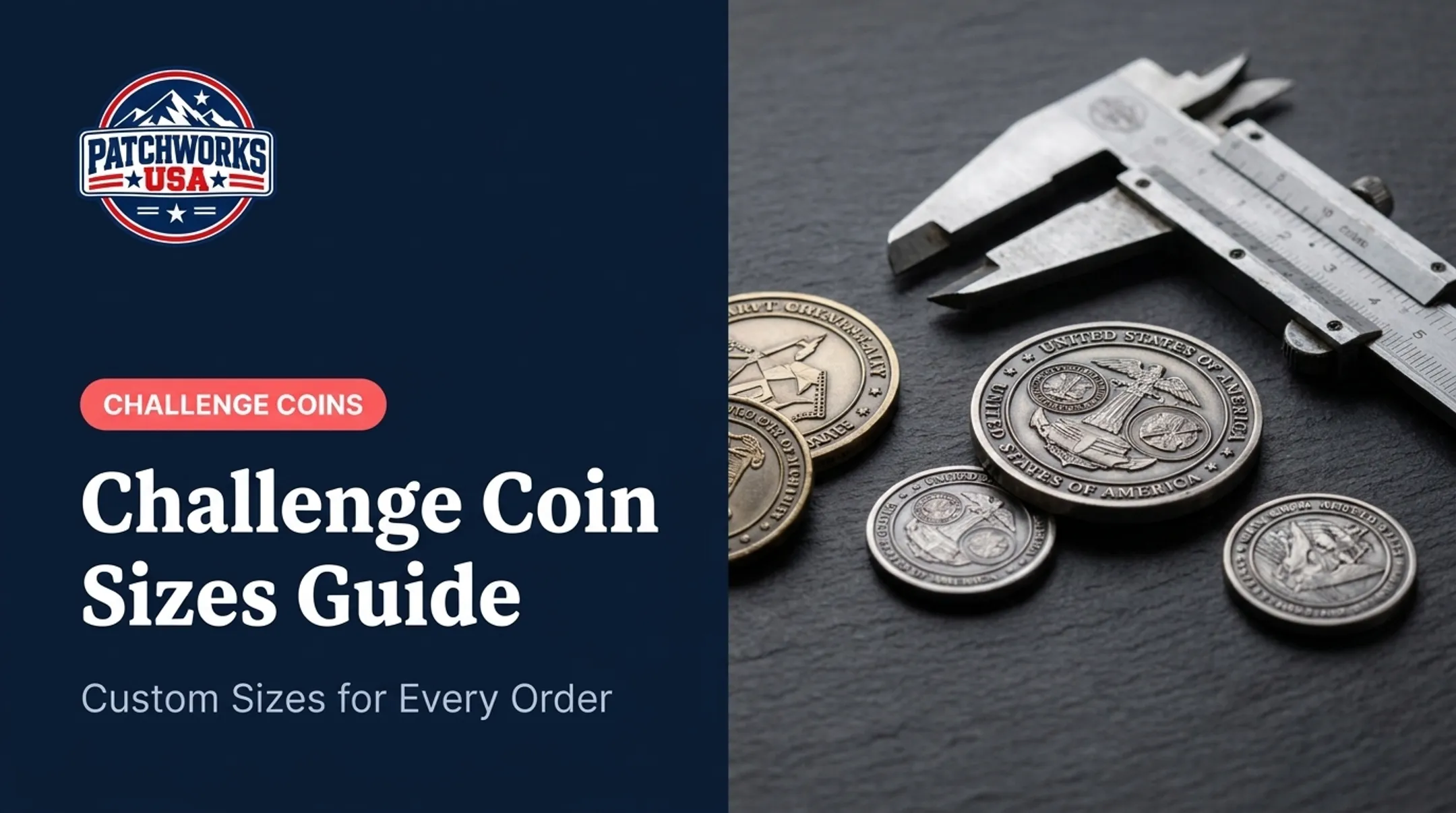
Suppliers cite 1.75 inches as an average, 1.5 inches as a small option and 2 inches as increasingly popular. GSJJ's size guide gives a broader range of 1.5 to 3 inches. None of these is a regulated standard.

Size drives legibility and pocket comfort. If your concept depends on maps, fine lettering or intricate logos, go larger or simplify. Custom shapes and cutouts add complexity, so confirm structure and durability with your manufacturer.
Decide between flat, sculpted and mixed construction
- 2D: flat, layered raised and recessed metal; best for crisp logos and readable text
- 3D: sculpted contours; best for form and depth
- Hybrid: relief for the focal point, flat enamel for supporting information
Build a deliberate color, plating and finish system
- Polished: reflective and formal
- Antique: darkened, then relieved so high points brighten and recesses gain contrast
- Black nickel: dark and dramatic
- Dual plating: two finishes on one coin, applied by masking
- Matte: usually describes the enamel, so ask what your supplier means
Soft enamel sits below raised metal and feels textured. Hard enamel is filled higher and polished flush. Terminology varies, so ask your manufacturer which options it actually offers.
Use edges and cutouts as part of the concept
Common edge treatments include:
- Rope: twisted cable texture
- Reeded: vertical grooves
- Cross-cut: diagonal grooves
Edges can frame the art or carry a short message. Cutouts and protrusions need structural review so the coin stays durable and comfortable to handle.
Test hierarchy, contrast and copy at actual size
Write a content plan for both faces: the must-have symbol, supporting imagery, essential wording and what gets cut if things get crowded. Then review an actual-size proof for spelling, contrast, thin lines, overlapping details and whether the main symbol reads at normal viewing distance.
Avoid Common Design Problems Before Ordering
- Overload: too many images, long slogans and detailed backgrounds become illegible. Shorten copy or move secondary details to the reverse or edge.
- Tiny type: Ultimate Promotions warns text below roughly 6-point equivalent at coin scale won't stamp cleanly. Confirm the minimum with your manufacturer, since thresholds vary.
- Gradients and photos: metal-separated enamel can't reproduce them. Use distinct color fields or ask about a manufacturer-approved printed process.
- Hairlines: one spinner template requires 0.75-point metal outlines and 0.4 mm minimum color areas. Limits vary by process.
- Third-party artwork: don't reproduce seals, agency badges, military marks, sports logos or entertainment characters without authorization. Use original art, get written permission and run a final rights check.

From Artwork to Finished Coins: What to Prepare
A short brief saves rounds of revisions. Gather:
- Purpose and recipient
- Quantity
- Preferred size and shape
- Must-have wording
- Color references
- Deadline
- Budget range
- Any approval requirements
You can start with finished artwork, a rough concept or reference images. Vector files (AI, EPS or PDF) give the cleanest strike or cast, and a PNG or a photo of an existing coin can start a quote. Ask what else is needed before the proof stage.
Patchworks USA makes coins from your own artwork. Owner Brad Aboff personally reviews submitted artwork, selects factories suited to the construction, returns one individually priced quote and oversees the order through proof approval and production.
Minimums start around 100 pieces, and typical production runs roughly 3 to 4 weeks after proof approval. Request a quote and expect a reply within one business day.
Frequently Asked Questions
What is the standard size of a challenge coin?
No single size is mandated. Suppliers commonly cite 1.5 to 3 inches, with 1.75 inches a frequent choice for balancing portability and detail. Lettering, imagery and construction should decide your final size.
Are challenge coins worth anything?
Most carry sentimental and cultural value, not resale value. Limited runs, condition, issuer and documented provenance can affect collectibility, but nothing guarantees a price.
Where did challenge coins originate?
Military origins are commonly cited, including a World War I pilot story, but one military source calls it unsubstantiated. Accounts of a modern start with Special Forces in the 1960s also conflict. Today the coins stand for recognition, belonging and commemoration.
Are there any challenge coins made in the USA?
Some suppliers offer U.S. production, while others use overseas or mixed supply chains. The FTC requires "all or virtually all" U.S. content for an unqualified Made in USA claim, so ask where coins are actually produced.
What should you put on a challenge coin?
Choose one primary symbol, concise identifying text and a meaningful date or phrase. Divide information among the front, back and edge so each stays readable.
How can I make a challenge coin design unique?
Start with an authentic story, then add an unusual but recognizable shape, one purposeful tactile feature or a limited color system. Finish with an actual-size proof and a permissions check.