
For military and veteran groups, police and sheriff departments, fire and EMS crews, schools, teams, brands and event organizers, that matters. A coin is handed over at a ceremony, carried in a pocket, then displayed for years. The edge is part of that impression.
This guide compares the common edge styles, shows where each fits, covers the trade-offs, and lists the proofing steps that help you approve with confidence.
Key Takeaways
- Edges range from quiet flat and bezel profiles to textured, reflective, engraved and custom options.
- Pick the edge that supports the artwork, message and plating, not the most elaborate one.
- Label the true side edge and the visible front and back rims separately on the proof.
- Compare shortlisted edges at the same size, thickness, finish and angle.
- Confirm feasibility, pricing, timing and text clearance before approval.
What Are Challenge Coin Edge Options, and Why Do They Matter?
What Is a Challenge Coin Edge?
The edge is the outer side of a metal coin, the part you see when you turn it or roll it between your fingers. Buyers and suppliers often use "edge," "rim" and "border" interchangeably, which causes confusion.
The visible face rim is different. It can carry text, dates, mottos or decorative framing. The U.S. Mint's anatomy of a coin defines the edge as the outer border and the rim as the raised part on both sides. That is terminology for coins in general, and challenge coin suppliers use the words more loosely.
Suppliers also name styles differently. One may call a bezel a raised rim, while another describes it as flat, reflective waves. Always ask what a name means for your coin.
Why Does the Edge Matter?
The edge sets the tone:
- A clean edge reads formal
- A rope edge feels ceremonial
- A spur edge looks bold and tactical
- A cut edge looks reflective and premium
Choosing without the rest of the design in mind causes problems:
- The edge competes with outer-ring text
- A rope edge repeats rope imagery on the face
- Busy texture hurts legibility
- The side profile feels rough in the pocket
How an edge looks also depends on diameter, thickness, shape, plating, finish and relief. A texture that looks sharp on a 2.5-inch coin may look crowded on a 1.5-inch one.

Challenge Coin Edge Styles
Flat, Bezel and Rope
Standard or flat: A smooth, uninterrupted profile. It suits detailed artwork, restrained branding and classic designs because it keeps attention on the faces. Patchworks USA lists smooth as a standard option.
Bezel: A sloped or faceted transition around the perimeter. It gives a finished look and controlled reflection, making it a good fit when you want refinement without a decorative pattern.
Rope: A twisted, braided texture tied to ceremony, service, heritage, unity and maritime themes. Some manufacturers describe it as angular rope-like lines.
A gold-plated Daytona 500 security-team coin and a navy, red and gold Parris Island coin both use it. Be cautious if the face already has rope imagery or crowded outer-ring text.
Cross-Cut, Diamond-Cut and Oblique-Line
A cross-cut edge has intersecting cuts that form diamond shapes and give reflective facets. An oblique-line edge has repeated diagonal or swirled lines.
ChallengeCoins4Less describes both as adding reflectivity and movement, though those are qualitative claims, not measured results.
Compare them under your chosen plating. Polished gold throws light very differently than antique nickel. Some suppliers also call oblique the "diamond rope cut," so check the sample.
Reeded, Spur and Chain
- Reeded: closely spaced grooves, suited to traditional or formal coins
- Spur: pointed, curved raised metal with a starburst effect, suited to bold or rugged designs
- Chain: a linked pattern that can suggest unity or strength
Weigh visual weight, tactile comfort and artwork compatibility. Spur reads more aggressive in the hand than reeded. Chain specifications vary by supplier, so request a sample image before committing.
Engraved and Fully Custom Edges
Edge engraving can carry names, dates, mottos, ID numbers or limited-edition details. Extra thickness gives lettering more room. A custom edge can follow an irregular silhouette or use a special pattern.
Feasibility, cost and production needs depend on the exact design and construction. Brass coins and cast zinc-alloy coins are finished in a different order, so ask how your coin will be made.

How to Choose the Right Challenge Coin Edge
- Start with purpose. Use restrained edges for formal recognition, corporate, commemorative or text-heavy coins. Use rope, chain or spur when the edge should say service, connection or strength.
- Review the artwork. Check outer-ring text, emblems, portraits, stars and repeated motifs. A quiet edge builds hierarchy. A stronger edge adds character to simple faces.
- Compare like for like. Ask for the same diameter, thickness, plating, finish and angle. Review a quiet baseline, a restrained texture and a thematic option.
- Consider handling. Pocket carry and frequent exchange favor comfortable textures. Display cases, capsules and fitted packaging can affect which profile works.
- Confirm before approving. Check that the edge works with round or irregular shapes, that details have clearance, and that the edge is in the quote.
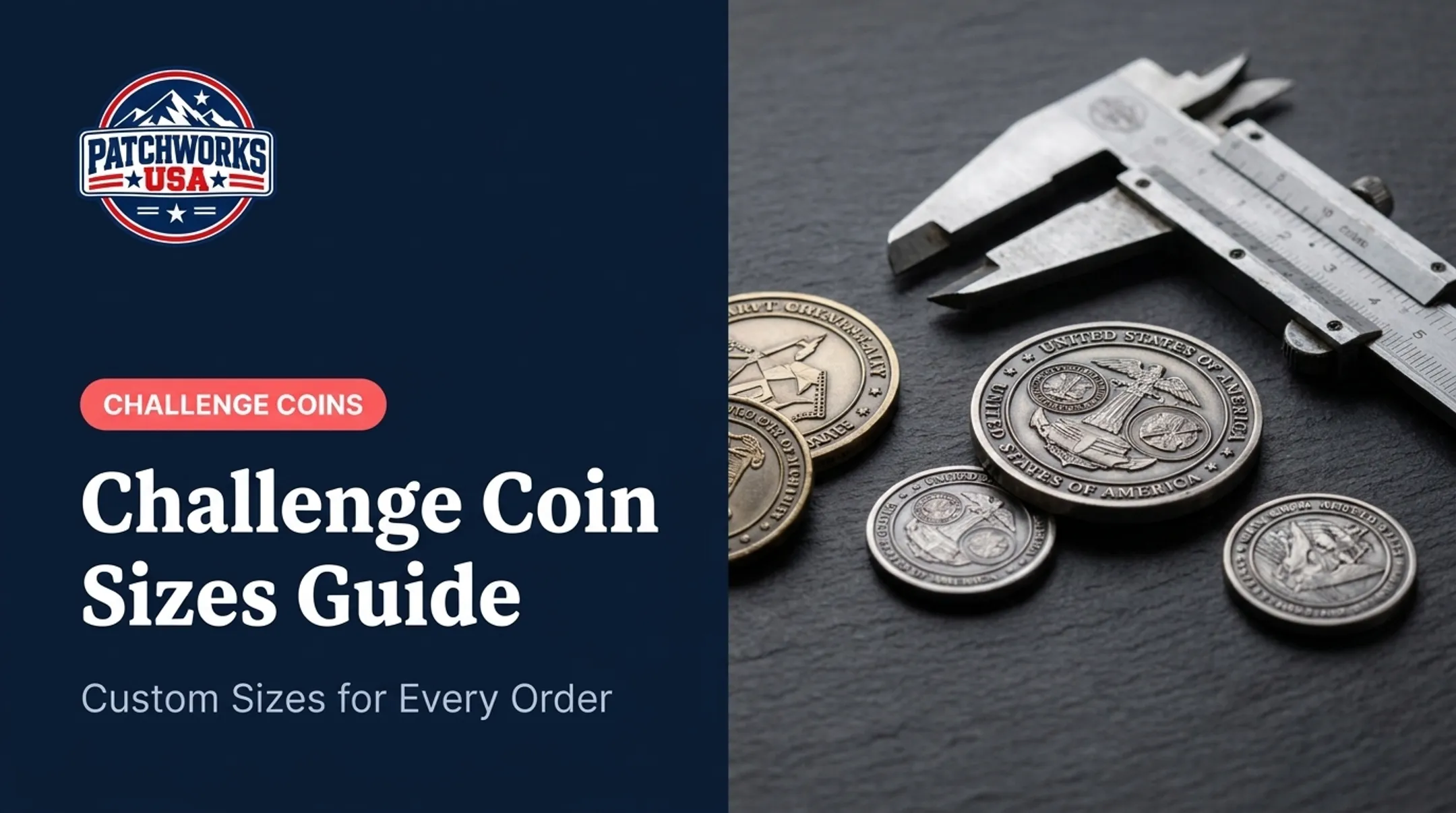
Typical sizes help frame the choice. Signature Coins reports an average of 1.75 inches across and 3 mm thick, with 4 mm offered as an upgrade. Patchworks USA lists thicknesses of 2.5 mm, 3 mm and 4 mm.
Patchworks USA can guide you through these steps. Owner Brad Aboff personally reviews submitted artwork, matches it to factories suited to the construction, returns one clear quote, and oversees the order through proof approval and production. Documented edges include smooth, rope, reeded and diamond cut, chosen after artwork review.
What to Check Before Finalizing Your Edge
- Label each part. Mark the true edge, front rim and back rim separately on the proof so everyone discusses the same surface.
- Request an angled view. The proof should show the edge pattern, dimensions, plating and finish. Review it alongside both faces for legibility and balance.
- Ask about feasibility. Confirm effects on price and timing, plus quantity, destination, deadline and packaging fit before the design is locked.
Pricing and timing differ widely by supplier. Some charge nothing for rope or spur edges; others charge per coin or per side, so compare units carefully.
Typical production at Patchworks USA is about 3 to 4 weeks after proof approval, with rush service available on request. Give your in-hands date up front.

Conclusion
Edges run from clean flat and bezel profiles to rope, cross-cut, reeded, spur, chain, engraved, and custom treatments. Each one changes how the coin looks and feels in hand.
The best choice supports your artwork, purpose, finish, dimensions, and handling. Compare like-for-like proofs and the production decision gets much easier.
Frequently Asked Questions
How do you make a custom challenge coin?
Submit artwork, choose construction, size, plating and edge, then approve a proof before production. Confirm dimensions, finish and quantity with the manufacturer. Vector files give the cleanest results.
Are there any challenge coins made in the USA?
Origin varies by supplier, so verify it directly. A US-based company is not the same as a coin manufactured in the United States. The FTC's guidance says a US address alone is not an origin claim.
What are the different types of edges on challenge coins?
Common options are flat or standard, bezel, rope, cross-cut, oblique-line, reeded, spur, chain, engraved and custom edges. Availability varies by supplier.
What is the standard size of a challenge coin?
No single standard exists. Many suppliers list 1.5, 1.75 and 2 inches. Confirm diameter, thickness and artwork legibility for your design.
Do decorative challenge coin edges cost more?
Sometimes. Some suppliers include rope or spur, while others charge for cuts. Impact depends on size, thickness, material, quantity, finish and shape.
What should a challenge coin edge proof show?
It should show the edge name or pattern, a side or angled view, dimensions, plating, front and back rims, text clearance and any custom-shape details.